Project-management-oriented work represents about 90 million jobs worldwide, roughly 3% of all employment, according to the Project Management Institute's global talent-gap analysis. That scale reflects what project teams learn quickly: delivery depends on more than a project manager. It takes people to fund and authorize the work, coordinate it, produce technical documents, track costs and schedules, and make accountable design decisions.
The practical answer to “who does what?” is to separate preparing and tracking work from approving decisions. A coordinator can maintain an RFI log and chase responses, for example, but shouldn't answer a design question or approve a cost increase without explicit authority. Titles overlap, especially in small firms, but decision rights still need to be clear.
The guide below maps common project management roles, shows how responsibilities shift outside construction, and follows work through project phases. It also gives you a practical way to delegate tasks, assign approvals, and test candidates before hiring.
Project Management Roles at a Glance
A project needs people who collectively control scope, schedule, cost, risk, technical quality, and communication. Titles change from firm to firm, but the work repeats. The table separates the person who prepares or directs work from the person who can approve it.
| Role | Main Responsibility | Decision Authority |
|---|---|---|
| Project sponsor | Funds the project and resolves top-level conflicts | Approves budget, scope, and major changes |
| Project manager | Owns scope, schedule, budget, and risk | Directs work within the approved budget and scope |
| Project coordinator | Runs logs, meeting follow-ups, and document flow | Routes items; no approval authority unless delegated |
| Scheduler | Builds and updates the project schedule | Recommends sequencing; doesn't approve delays |
| Cost estimator | Prepares takeoffs, budgets, and pricing | Prepares estimates; project manager or owner approves |
| Document controller | Maintains the current drawing and document set | Controls versions; doesn't revise design |
| BIM coordinator | Coordinates models and runs clash checks | Flags conflicts; design team resolves them |
| Discipline lead, architect or engineer | Owns design content and code compliance | Approves technical design and professional sign-off |
| Client representative | Speaks for the owner on decisions | Approves scope, cost, and payment decisions |
Separate production from approval
The authority column is the key to reading the table. People who prepare, route, or track an item make the process move; people with delegated, contractual, or professional authority accept the risk of the decision. Confusing the two creates familiar problems: an unapproved substitution gets ordered, a draft change is treated as accepted, or a coordinator is expected to resolve a technical issue they don't own.
Some workflows call for additional specialization. For example, firms handling electrical equipment procurement may need a clear process for coordinating technical requirements, purchasing, and project milestones. A resource on project management for electrical procurement can help frame those interfaces. For a broader view of how preconstruction roles fit together, see this guide to preconstruction team roles and responsibilities.
Small firms often combine several rows in one person. A principal might sponsor the project, represent the client, and lead design; a project manager might also update the schedule. That can work if everyone still knows which capacity the person is acting in and what authority comes with it.
Quick check: List each role, name its owner, and flag any role with no owner. Then identify who approves each major decision, not just who prepares the paperwork.
How Project Roles Shift Outside Construction
The same division of responsibility applies in software, healthcare operations, marketing, and internal change programs, even when teams use different titles. An executive sponsor funds the work and resolves priority conflicts. A project manager manages scope, schedule, budget, and risk. Team leads and subject-matter experts produce the technical work, while a PMO analyst maintains shared reporting, templates, and portfolio records.
Agile teams introduce another distinction. The product owner prioritizes what the team builds next, while the scrum master supports the team's process and helps remove blockers. A project manager may still coordinate dependencies, dates, budgets, and stakeholder communication, but shouldn't assume that role includes product prioritization.
The approval point changes with the delivery method
In a more sequential, or waterfall, project, the team establishes an approved baseline and manages proposed changes against it. In an agile team, priorities can be reordered as work progresses, so the product owner's decisions about what comes next are central. Neither arrangement removes the need for cost controls, clear accountability, or escalation when a decision exceeds someone's authority.
Consider a clinic-software rollout. The executive sponsor owns the funding decision, a PMO analyst maintains the risk log, and the product owner chooses which workflow should be delivered first. The project manager coordinates dependencies such as training, testing, and communications. A regulated decision still belongs to the named accountable officer or qualified professional, not the person who updates the project dashboard.
Smaller teams may combine PMO analysis and project coordination in one position. That's efficient when the person can maintain the records without becoming the approval authority by accident.
Before work begins, map each role to one decision and one deliverable. If two titles appear to claim the same decision, name the final approver and document how the other role contributes.
What the Project Manager Owns Day to Day
The U.S. Bureau of Labor Statistics reported 1,094,300 project management specialist jobs in 2025 and projects employment to reach 1,167,400 by 2035, a 6.7% increase (BLS employment projections). The broad occupational category helps explain why the title can mean different things across employers. In construction, the useful test isn't the title alone. It's whether the person can keep the project's controls current and make exceptions visible.
Five controls, one operating picture
Scope defines what the team will deliver and how proposed changes are reviewed. The project manager makes sure the approved work is clear and routes scope changes to the people authorized to accept them.
Schedule turns that scope into activities, milestones, and dependencies. The project manager checks progress against the plan, identifies impacts to the critical path, and reports delays rather than moving dates without notice.
Cost compares the approved budget with commitments, actual costs, and the expected cost to complete. Estimators or cost analysts may prepare the figures, but the project manager connects variance to decisions and escalates it.
Risk requires a live record, not a list created at kickoff and forgotten. Each material risk needs an owner, an assessment, and a response that the team can act on.
Communication sets the meeting rhythm, reporting cadence, and escalation route. It makes sure the right people receive decisions and status in time to respond.
A fit-out delay, handled as a control issue
Suppose a window package for a commercial fit-out arrives six weeks late. The project manager checks which installation and follow-on activities depend on the delivery, asks the scheduler to test sequencing options, and gets an updated cost impact from the estimator. The owner receives clear options, such as resequencing work or accepting a later milestone, with the consequences recorded for approval.
The manager directs the analysis and makes sure the decision is documented. That doesn't mean they personally produce every schedule revision, price every change, or approve a design substitution. Their job is to keep the approved plan and forecast aligned, then take exceptions to the person with the authority to decide.
On a small residential job, one person may handle coordination and site leadership. When hiring for that combined role, ask the candidate to show how they'll manage both the records and the field-facing decisions. A practical interview request is a sample weekly status report: look for clear progress, upcoming work, unresolved actions, cost or schedule concerns, and named owners.
How Work Hands Off Across Phases and Where It Breaks
A project advances through phases, but work doesn't move automatically from one team to the next. Each stage needs a usable handoff: a defined output, current information, and a receiving person who knows what to do with it. A sponsor can authorize a project, for instance, but the project manager still needs a clear scope and budget range before building the plan.
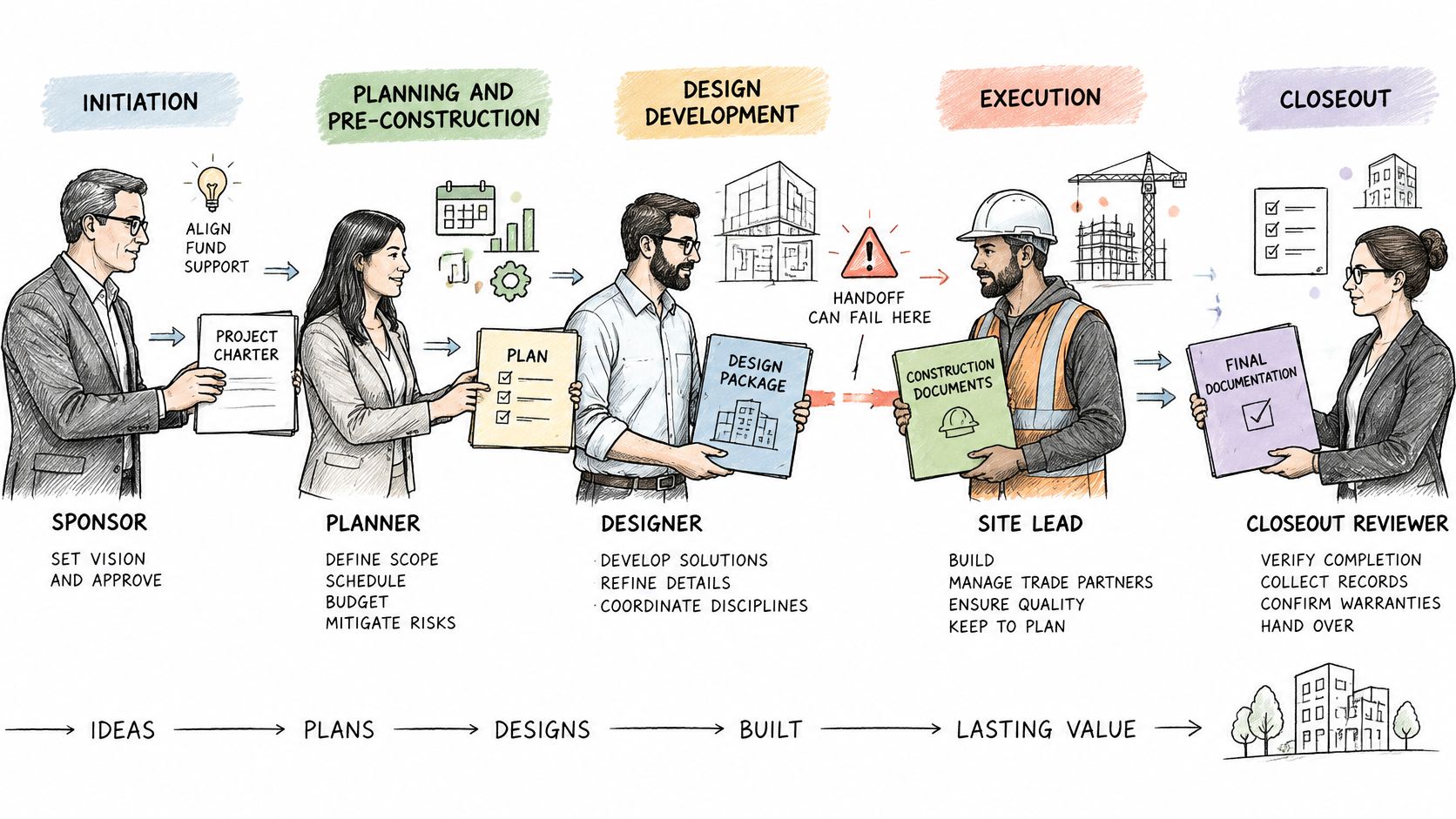
| Phase | Lead Role | Key Support | Handoff Output |
|---|---|---|---|
| Initiation | Project sponsor | Project manager | Approved scope and budget range |
| Planning and pre-construction | Project manager | Estimator, scheduler | Baseline schedule and cost plan |
| Design development | Discipline lead | BIM coordinator, document controller | Coordinated design package |
| Execution | Project manager | Project coordinator, subcontractors | Weekly status report, RFI and submittal logs |
| Closeout | Project coordinator | Document controller | Final record set and closed punch list |
Make the next person's starting point explicit
During initiation, the sponsor hands the project manager an approved charter or equivalent record that defines the scope and budget range. In planning and preconstruction, the estimator and scheduler support a cost and schedule baseline that the authorized owner or project leadership approves. During design development, the discipline lead provides a coordinated package that the execution team can use, while the document controller establishes which version is current.
Execution generates a steady stream of decisions, records, and status updates. The project manager needs an accurate weekly picture of work, open RFIs, submittals, and changes. At closeout, the coordinator and document controller assemble the final record set, including outstanding punch-list items and required as-built information, so the owner receives a controlled handoff rather than a folder of unverified files.
Keep records aligned during each phase
Handoffs fail when notes are incomplete, an open item has no named owner, or the next person starts from someone else's memory. A one-page handoff record should list each open item, its owner, due date, status, and any decision needed. Both the person handing the work off and the receiver should confirm the record is complete.
Work can also break down within a phase. Teams may build from superseded drawings, record RFIs without due dates, or let schedule and procurement information drift apart. Use one document system with a clear version rule. For each RFI, capture the number, specification section, responsible party, due date, and status. Meeting minutes should name an owner and deadline for each action, then be issued promptly enough to guide the work.
Set a clear escalation threshold for overdue actions and reconcile the schedule, procurement status, design deliverables, and change log each week. Each extra field adds administration, so keep the register focused on information someone uses to make or route a decision. In design-build delivery, one organization may hold several roles, but internal handoffs still need an accountable receiver and a record of what changed.
Who Owns RFIs, Submittals and Change Orders
An RFI asks a question. A submittal sends something for review, such as a shop drawing, equipment cut sheet, or sample, before fabrication or delivery. A change order records an agreed modification to scope, cost, schedule, or all three. These are separate control documents with separate approval routes, and teams create problems when they route all three through one inbox and one owner.
| Item | Usually Raised By | Reviewed By | Approval Authority |
|---|---|---|---|
| Request for information (RFI) | Contractor, subcontractor, or supplier | Architect or design team | Design team answers; owner or delegated authority approves any scope change |
| Submittal | Contractor or supplier | Design team, routed by the project manager | Design team reviews; project manager tracks status and deadlines |
| Change order | Contractor, design team, or owner | Project manager, estimator, and owner | Owner or delegated authority approves scope, cost, and schedule changes |
The project manager owns the register and the escalation. The design team owns the technical answer to an RFI and the review of a submittal. The owner or delegated authority owns the contractual change. A coordinator can keep all three moving, but cannot approve a substitution or authorize cost. That boundary is about authority, not seniority.
Track the chain, not just the individual document
An RFI response can clarify an ambiguity without changing the contract. If the answer changes the contracted work, the team may need a change-order request. A delayed submittal can create another link: late review may affect procurement or installation, which then needs to be assessed and documented as a schedule impact.
The coordinator's job is to keep that chain visible. Assign each item a number, specification section, responsible party, due date, and status. Route it to the reviewer, circulate the response, preserve the approval record, and connect the item to any related change order. The project manager uses those records to identify schedule or cost exposure and escalate decisions.
A mechanical RFI about duct clearance shows how the handoffs work. The design team responds five business days later with a routing change that affects ceiling sequence and adds cost. The coordinator records the answer and links it to the change request. The project manager assesses schedule and cost exposure. The owner approves the contract change. Each person has a defined output, and no one signs outside their authority.
If your team uses cross-industry scheduling analogies to think about dependency chains, a reference on test manufacturing line balancing scenarios can frame that comparison. It does not decide who approves a change on a construction job. Keep the supporting records organized with a defined set of project management documents.
On design-build or delegated-design work, one person may sit in two of these seats. Write down which role they are filling for each document. A coordinator should not approve a technical substitution, change contracted scope, or authorize a cost increase unless the client's procedures expressly delegate that authority. Check the contract and approval matrix before the workflow goes live.
Delegating Project Tasks and Setting the Role Split Before You Hire
The cleanest delegation rule is prepare versus decide. Remote staff and coordinators can assemble information, maintain records, follow up on overdue items, and flag exceptions. The decision remains with the person who holds the necessary professional, contractual, or organizational authority.
| Task | Can Be Delegated To | Keep With |
|---|---|---|
| Quantity takeoffs | Estimator or takeoff specialist | Estimating lead, who checks pricing |
| Schedule updates | Scheduler or project coordinator | Project manager, who approves baseline changes |
| Meeting minutes and action lists | Project coordinator | Project manager, who confirms owners and dates |
| Budget variance reports | Estimator or cost analyst | Project manager, who explains and escalates variances |
| Code compliance review | Not delegated to coordinators | Licensed architect or engineer |
| Design decisions and substitutions | Not delegated to coordinators | Design team and owner |
| Contract interpretation | Not delegated to coordinators | Project manager with contract or legal support |
| Professional sign-off | Not delegated | Licensed professional of record |
| Field safety decisions | Site superintendent or safety lead | Authorized person on site |
Define outputs and review points
Start by naming the internal approver for every output. Set due dates for the RFI log, submittal register, weekly schedule report, and closeout archive. Then set a weekly project-manager review of logs and overdue items, plus a monthly budget-variance check by the estimating lead. Those reviews catch missing information while the team can still act on it, instead of discovering it during closeout.
Test candidates on the work they'll perform. A takeoff can reveal whether an estimator follows drawing references and documents assumptions; a schedule exercise can show whether a candidate understands dependencies and communicates slippage. For other roles, a markup set or design and documentation exercise can test the relevant production skills. HireArchitects uses practical tests matched to the role, including takeoffs, drawing markups, and design or documentation exercises.
Before the role starts, confirm the jurisdiction, delivery method, contract terms, required software, and who supplies licenses. Those factors can shift the boundary between support and authority. Where obligations are unclear, get guidance from qualified counsel or a compliance professional. Keep licensed sign-off and contract authority with the people authorized to hold them.
A remote project manager may maintain schedules, RFIs, submittals, change orders, subcontractor follow-up, and owner reporting. The operating benefit depends on a clear review path, not on moving accountability out of the firm. HireArchitects' project-management staff work in tools such as Procore, Buildertrend, and Monday, and typically keep U.S. business hours to join meetings, bid reviews, and site calls live.
For a focused hiring process, start with a short scoping call: the prospective client identifies the role, software, and hours needed on a 20-minute call. Then assess candidates against the actual workflow, not a generic job description. Define who reviews each deliverable and write the decision boundary into the role description. You can also use this guide to project management advisors when deciding what support fits your team.
The Takeaway
Effective project management roles are defined by clear ownership and decision authority, not by titles alone. Assign someone to produce and track each key deliverable, name the person who approves it, and create a documented handoff whenever responsibility changes.
Before adding capacity, map the work, set review points, and test candidates on the tasks they'll handle. Keep technical sign-off, contractual approvals, and other accountable decisions with the authorized people.
If you're defining a project coordinator, scheduler, or project manager role, HireArchitects connects U.S. firms with remote AEC professionals and supports role-specific candidate screening. Share the work, software, and hours you need, then visit HireArchitects to discuss a shortlist.