Most outsourcing trouble in architecture and construction shows up after work is already underway: an RFI sits unanswered, a drawing comes back with markups that don't match your standards, or your estimator is booked two weeks out. Those symptoms usually point to one of three underlying problems: communication breakdowns, quality drift, or a mismatch between the capacity you've bought and the work you need done.
The right solutions to outsourcing challenges depend on which problem is constraining the team. Nearshore staffing can make live coordination easier, a managed production service can take on defined documentation work, and project-based estimating can absorb bid spikes without adding a continuing role. None of these models removes the need for clear scope, review ownership, or reliable handoffs. Here are seven options, with the trade-offs that determine where each one fits.
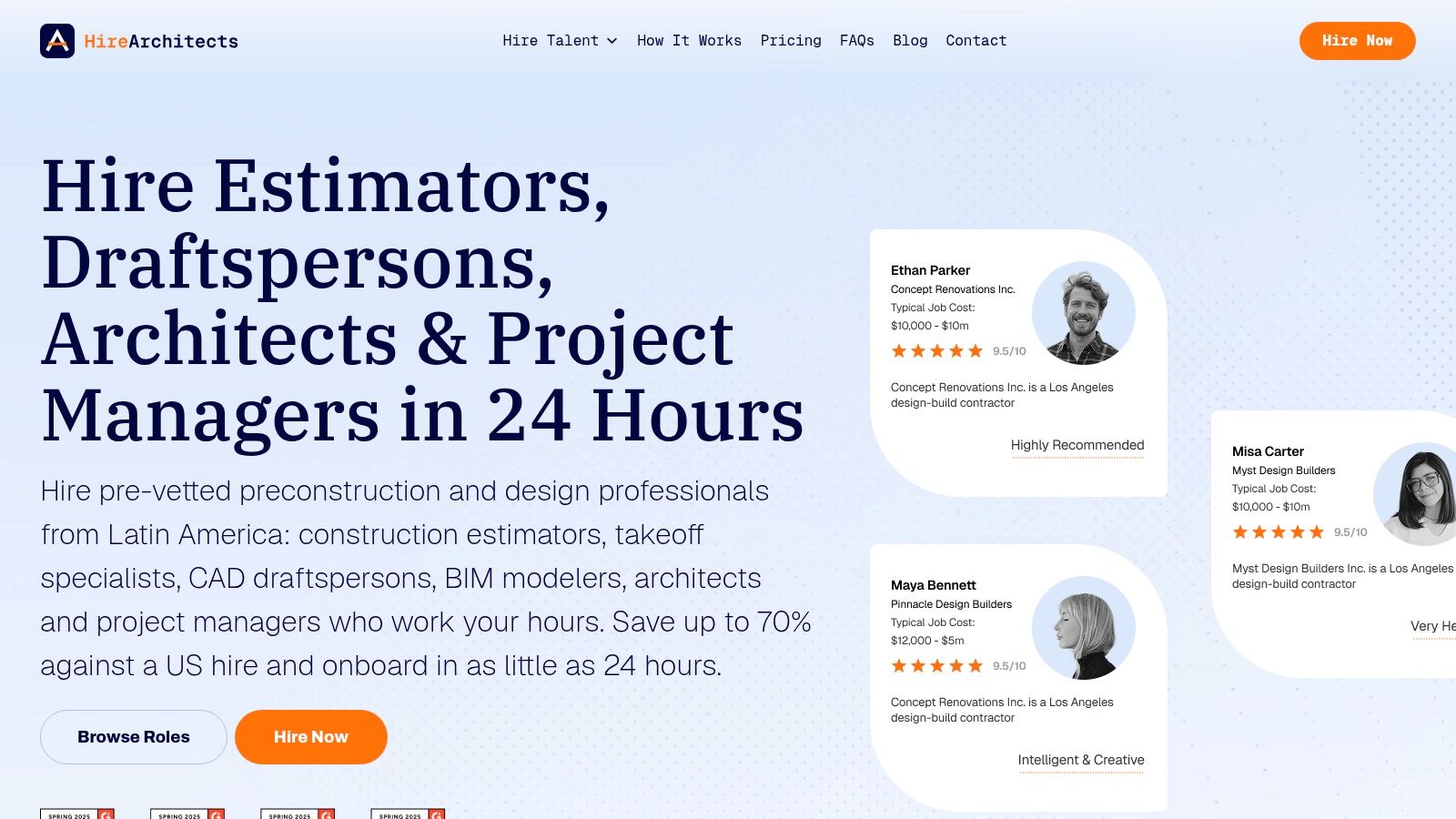
1. HireArchitects for flexible remote AEC staffing
When the backlog crosses several disciplines, a staffing model can help you add capacity without treating every new project as a separate vendor assignment. HireArchitects connects U.S. architecture, engineering, and construction firms with remote professionals based in Latin America. Roles span estimating and preconstruction, drafting and BIM, architectural and MEP design, and project coordination, including takeoffs, permit and construction-document sets, model coordination, schedules, RFIs, and submittals.
Best fit for an ongoing capacity gap
The practical advantage is continuity. A remote draftsperson can learn your sheet standards and revision conventions, while an estimator can work within your takeoff assumptions and bid templates. HireArchitects screens candidates through interviews, English checks, portfolio and experience reviews, and role-specific practical tests. After a scope call, firms receive a shortlist of three candidates within 24 hours, and many hires start within 24 to 72 hours. Professionals generally work U.S. business hours, which supports live bid reviews and drawing coordination.
Monthly full-time and part-time arrangements give firms room to match staffing to recurring demand. Published starting prices are $1,999 per month for draftspersons, $2,299 for estimators, $2,399 for BIM modelers, $2,799 for architects, and $2,999 for project managers. Senior hires can reach about $3,500 per month, and the company advertises savings of up to 70% compared with U.S. hires. Compare the full workflow cost, not just the monthly rate: onboarding, software, reviewer time, and the cost of maintaining quality still belong in the calculation.

Keep authority clear: Remote professionals can prepare production work, but the client's licensed architect or engineer retains responsibility for code interpretation, regulated approvals, and sign-off.
Trade-offs to settle before hiring
Most firms provide access to tools such as AutoCAD, Revit, Bluebeam, or Procore, so confirm permissions and license availability before the start date. The model can address capacity mismatch and, with overlapping work hours, reduce communication lag. It won't fix vague drawing standards or absent internal review. Give the new hire a named reviewer, sample approved deliverables, and a clear escalation path before assigning live work.
2. ArchiStaffing for embedded nearshore production
ArchiStaffing may suit studios that need an ongoing contributor who works within the firm's day-to-day team, rather than a vendor delivering a discrete package. Its nearshore architecture and construction staffing includes Latin American BIM designers, CAD specialists, and interior designers, with full- or part-time options.
The nearshore arrangement supports working-hour overlap, which can help when a drafter needs a quick answer about a dimension, layer convention, or redline. Clients can interview candidates and request optional technical assessments. ArchiStaffing handles employment and onboarding, while the studio still sets priorities, provides project context, and reviews the work.
That division of responsibility is the main trade-off. Embedded staffing gives a firm more day-to-day direction than a fixed-scope production package, but it also means the firm needs someone available to manage the queue. If a principal sends scattered markups through email, chat, and PDFs without a single revision record, the location of the drafter won't solve the coordination problem.
A remote contributor needs one current source of truth for drawings, comments, and deadlines. Without it, “quick revisions” become competing versions.
Pricing isn't published, and public details about contract terms, guarantees, and placement timelines are limited. Before engaging, define who assigns work, how the candidate's technical fit will be tested, which standards they'll follow, and how either side handles a mismatch. This option is more compelling when production demand is steady enough to justify an embedded role than when you only need occasional help with one set.

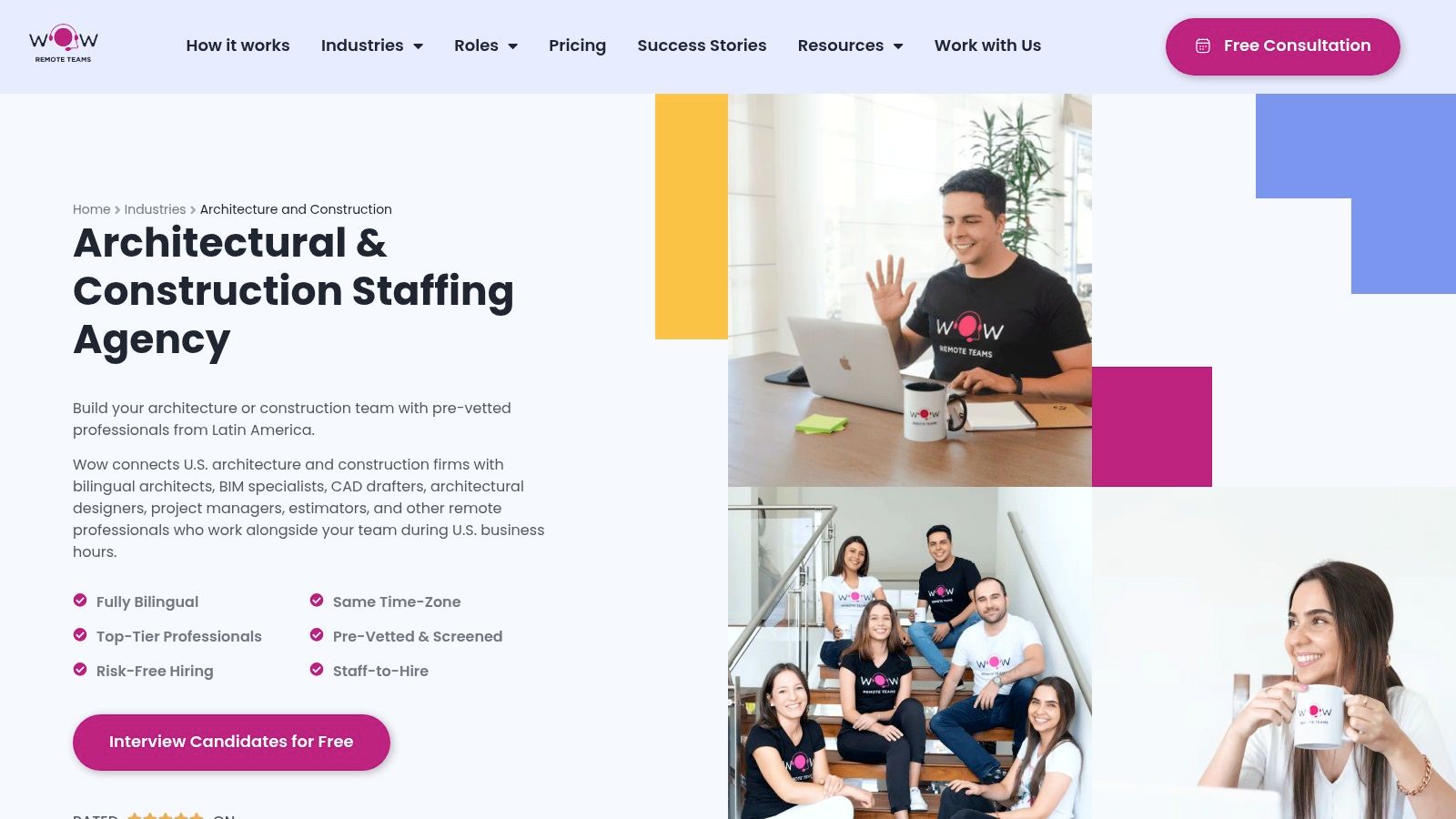
3. Wow Remote Teams for multiple hiring models
A studio may need drafting capacity now but want the option to hire directly later. Wow Remote Teams' architecture and construction staffing offers monthly staffing, staff-to-hire, and direct-hire arrangements. Listed roles include architects, BIM specialists, CAD drafters, project managers, designers, and estimators.
Wow Remote Teams handles sourcing, screening, onboarding, contracts, and payments. Its screening may include English, software skills, portfolios, and relevant experience. The provider says candidates work U.S. business hours, offers a shortlist of three professionals, and states a shortlist timeline of three to five business days. Those terms describe the hiring process, not the quality of a candidate's production work.
Test the work before assigning a live project. A portfolio can show polished models without proving that someone follows your Revit families, drawing standards, or coordination process. Use a representative task, such as revising a sheet from redlines or checking a model against a documented naming convention.
Pricing varies by role and experience, with no fixed AEC-specific monthly rate shown. Confirm what the replacement guarantee covers, when billing starts, and how the provider assesses role-specific skills. This model can address a capacity gap, but it will not resolve communication breakdowns caused by scattered instructions or quality drift caused by missing standards and review steps.
4. VOID for architecture and BIM production
VOID focuses on architecture and BIM production support, connecting Latin American architects and BIM specialists with U.S. and European firms. Its architecture and BIM services emphasize fitting production into a client's tools, workflows, and standards, with teams intended to scale alongside project demand.
That production focus may appeal to a BIM-heavy practice that needs output capacity rather than recruitment alone. A firm could use the service to work through a documentation backlog or add model production during a busy project phase. Nearshore collaboration can also make it easier to resolve model questions while the project team is working.
Clarify the service boundary
Public information on precise role coverage, deliverables, and service-level terms is limited. Pricing, minimum engagement, and onboarding timelines aren't published, so establish whether the proposed engagement is an individual contributor, a managed team, or a project-based service. Those models carry different expectations for daily direction, continuity, and acceptance of deliverables.
A production-focused provider can help address quality drift when it documents how its team will use your standards and handle review comments. But “integration” needs to mean something operational: which model is authoritative, how revisions are named, who resolves design questions, and what happens when a clash or missing detail blocks production. Put those decisions in the kickoff scope, not in informal messages after work starts.
VOID may fit firms with a defined architecture or BIM workflow and a need for scalable production support. It's a less obvious choice if you need a broad range of estimating and project-administration roles, or if the engagement terms don't match the level of oversight your team can provide.
5. BidAccurate for project-based preconstruction support
If the immediate problem is a bid deadline rather than a permanent staffing gap, project-based estimating can be a better fit than hiring a dedicated employee. BidAccurate offers estimates and quantity takeoffs alongside BIM models, shop drawings, architectural drafting, permit drawings, and renderings. Clients can request one-off work or a monthly dedicated estimator.
Its estimates and takeoffs are delivered in PDF and Excel, and its tools include Autodesk products, PlanSwift, Bluebeam, and RebarCAD. That combination lets contractors and design firms send a defined package of work without first building a continuing role around it. It can also help when estimating demand fluctuates with bid volume.
The main distinction is control and continuity. A one-off service can absorb a busy bid period, but it won't become part of your internal estimating rhythm unless you define reusable assumptions and templates. A monthly estimator may provide more continuity, but it isn't the same as directly hiring an employee. Confirm expected hours, availability, and how project priorities are handled before treating that arrangement as dedicated capacity.
Project fees are quoted after the provider reviews the documents, and your team still needs to validate scope coverage, quantities, and assumptions before using an estimate. For a fair cost comparison, include the time your estimator currently spends on takeoffs, bid preparation, and review, not only the quoted fee. This construction-estimator cost guide can help frame the difference between project work and monthly staffing.
6. F&K Estimatings for quantity takeoffs and bid preparation
F&K Estimatings is focused on takeoffs, cost estimates, and bid-preparation support for contractors. A client can request quantities only or a priced estimate with agreed labor, material, and other cost components. The provider says its deliverables include marked-up drawings and quantities organized using CSI MasterFormat, which can make review easier when the output matches the contractor's bid structure.
The quantity-only option is particularly useful when you want to keep cost assumptions in-house. For example, a specialty contractor can request measured quantities, then apply its own local labor rates, supplier pricing, waste factors, and productivity assumptions. F&K covers commercial, residential, industrial, electrical, plumbing, and HVAC work, and uses PlanSwift and Bluebeam Revu for takeoffs.
Use sample outputs to check fit
F&K provides sample deliverables for review before project scoping, and its published price ranges can help with early budgeting. Final fees and delivery dates still depend on document quality and agreed scope. Before assigning a live bid, check whether the sample marks exclusions, alternates, and unclear conditions in a way your team can act on.
This provider is an estimating option, not a broad source of ongoing drafting, BIM, or project-administration staffing. You remain responsible for validating local costs, scope coverage, and assumptions before submitting a price. Firms building or adjusting their estimating function can use this guide to preconstruction team roles and responsibilities to clarify which tasks belong with estimators, coordinators, and reviewers.
7. K2E for variable general-contractor bid volume
K2E is oriented toward general contractors that need flexible estimating support. Its estimating services include itemized estimates with quantity takeoffs and priced labor and materials, formatted to the contractor's template. It also offers takeoff-only work, subcontractor sourcing, and quote leveling.
Template-based deliverables can reduce reformatting when the contractor already has a settled bid process. The provider says its estimators flag scope gaps and conduct a second review, and it advertises next-business-day delivery. Treat that timing as something to confirm for each assignment. A large, incomplete document set or a bid with unusual phasing may need a different schedule than a straightforward package.
Quote leveling extends the service beyond measurement: the contractor can compare subcontractor proposals and identify missing or inconsistent scope before finalizing a bid. That can help when estimating capacity is the constraint, but it doesn't replace the GC's commercial judgment about exclusions, risk, and final pricing.
K2E is less suited to architecture firms seeking drafting or BIM staff because its focus is estimating. Pricing isn't shown in the reviewed material, so obtain a quote based on the actual documents and deadline. Before sending work, confirm the bid template, cost assumptions, expected review steps, and the person who will resolve questions. These details are where communication failures tend to surface, even when the estimating deliverable itself is technically sound.
How the seven providers differ in engagement model, pricing disclosure, and best-fit use
| Item | Engagement model | Pricing disclosure | Best fit for |
|---|---|---|---|
| HireArchitects | Full- or part-time monthly remote staffing | Published role-based starting prices; no placement fee or long-term commitment | AEC firms needing flexible, pre-vetted remote talent across design, preconstruction, and project coordination |
| ArchiStaffing | Full- or part-time embedded staffing; provider handles employment and onboarding | Custom quote; pricing not published | Studios seeking ongoing nearshore architecture or construction production capacity |
| Wow Remote Teams | Monthly staffing, staff-to-hire, or direct hire | Varies by role and experience; no fixed AEC-specific rate shown | AEC firms seeking a range of LATAM roles and multiple hiring models |
| VOID | Architecture and BIM production support; engagement structure to confirm | Pricing and minimum engagement not published | Firms needing flexible, workflow-aligned architecture or BIM production capacity |
| BidAccurate | One-off project services or a monthly dedicated estimator | Project fees quoted after document review | Contractors and design firms needing outsourced estimating, takeoffs, or related drafting and BIM services |
| F&K Estimatings | Quantity takeoffs, priced estimates, or bid-preparation support | Published price ranges; final fees depend on scope | Contractors seeking outsourced takeoffs and estimating support |
| K2E | Outsourced estimating, takeoffs, subcontractor sourcing, and quote leveling | Pricing not shown; requires a quote | General contractors with fluctuating bid volume needing estimating support |
The Takeaway: Match Each Solution to Your Bottleneck
Name the bottleneck first. If the problem is communication, favor a model with real working-hour overlap and a named person who can resolve questions quickly. If quality control is slipping, define drawing standards, estimate assumptions, review gates, and acceptance criteria before production starts. If capacity is the constraint, decide whether the workload is steady enough for monthly staffing or better handled as project-by-project estimating.
For a drafting backlog, a monthly remote hire may fit when your team already works in Revit and Procore and can provide software access, clear standards, and a reviewer. If you need bid-by-bid estimating, a project-based provider may suit you better than adding a continuing role. A staffing arrangement won't resolve unclear scopes, inconsistent markups, or missing internal review, so set up the workflow alongside the engagement.
A practical first step is a 20-minute call covering the role, software stack, and hours needed. That gives you a concrete basis for deciding whether a remote hire matches the bottleneck, and what responsibilities should stay with your licensed or internal team.
HireArchitects connects U.S. firms with vetted remote professionals in Latin America for estimating, drafting, BIM, design, and project coordination, with full-time and part-time monthly arrangements. If you're assessing whether remote staffing can address a specific communication, quality, or capacity issue, share your role, software, and hours needs with HireArchitects.