Your project didn't fail at the deadline. It failed six weeks earlier, in a kickoff conversation nobody wrote down, when the sponsor assumed three revision rounds were included, the design team assumed one, and both sides left confident they'd agreed. Project management requirements are the written controls that prevent that gap. They're not a folder of kickoff paperwork. They're the operating rules that define what's included, who approves it, what record proves it was done, and how a change gets priced before anyone acts on it.
That distinction matters whether you're running a construction package, an EHR rollout, or a vendor transition in a medical practice. If a requirement lives only in someone's memory, it isn't a requirement. It's an assumption waiting to become a dispute.
The Core Requirements Every Project Needs
Six weeks into a project that started on a verbal brief, the sponsor asks why permit coordination isn't in the fee. The team says it never was. Neither side is lying. They just never signed the same definition of scope. I would score any active project against seven categories before looking at software, staffing, or a new template.
Seven Categories That Need an Artifact
Scope defines work included and excluded, and the exclusions matter as much as the inclusions. Deliverables and standards name each document, model, or product due, plus its format and quality criteria. Schedule and budget turn good intentions into dates and a cost baseline someone approved.
Roles and approvals state who performs, reviews, and signs off each item. Communication sets meeting cadence, report content, and recipients so status doesn't depend on who happens to ask. Change control explains how requests are logged, assessed, and approved before work shifts. Teams comparing support models often review project management for engineering work at this point to see which of these controls they'd keep in house.
| Requirement | What It Defines | Example Artifact | Typical Owner |
|---|---|---|---|
| Scope | Work included and excluded | Signed scope statement with an exclusions list | Project sponsor and project manager |
| Deliverables and standards | Documents, models or products due, with format and quality criteria | Deliverables register that references applicable standards | Project manager and technical lead |
| Schedule | Milestones, dependencies and approval windows | Baseline schedule with milestone dates | Project manager or scheduler |
| Budget | Approved cost baseline and contingency | Cost baseline with a named contingency line | Project sponsor and finance lead |
| Roles and approvals | Who performs, reviews and signs off each item | Responsibility matrix (RACI) | Project manager |
| Communication | Meeting cadence, report content and recipients | Communication plan with report template | Project manager |
| Change control | How requests are logged, assessed and approved | Change log and written approval procedure | Project manager and sponsor |
What This Looks Like in Practice
Say a 12 provider primary care practice moves prior authorization work to a new vendor. The baseline should name who approves the workflow change, which payer forms and rules are in scope, and the turnaround time that counts as on time. Without those three lines, the vendor has to interpret a verbal brief, and the practice manager can't tell poor performance from a poorly written requirement.
Capacity belongs in the requirements too. A 2025 global survey of more than 2,000 AEC professionals found lack of time was the largest technology adoption barrier, cited by 30% of respondents. If nobody has hours protected to maintain the logs, the controls will decay no matter how good the template looks.
A small internal project can combine several artifacts into one document. A regulated or publicly funded project will need compliance and reporting requirements beyond this table. Score your current project against the seven rows today, and flag the two that exist only in people's memory. Those are your first fixes.
How to Gather and Validate Requirements Before Work Starts
Many teams rush this stage because production feels more billable than definition. That trade is expensive. The Project Management Institute Pulse of the Profession research found that inaccurate requirements management contributed to failure to meet project goals in 47% of unsuccessful projects. You don't fix that with a longer kickoff meeting. You fix it with a sequence you finish.
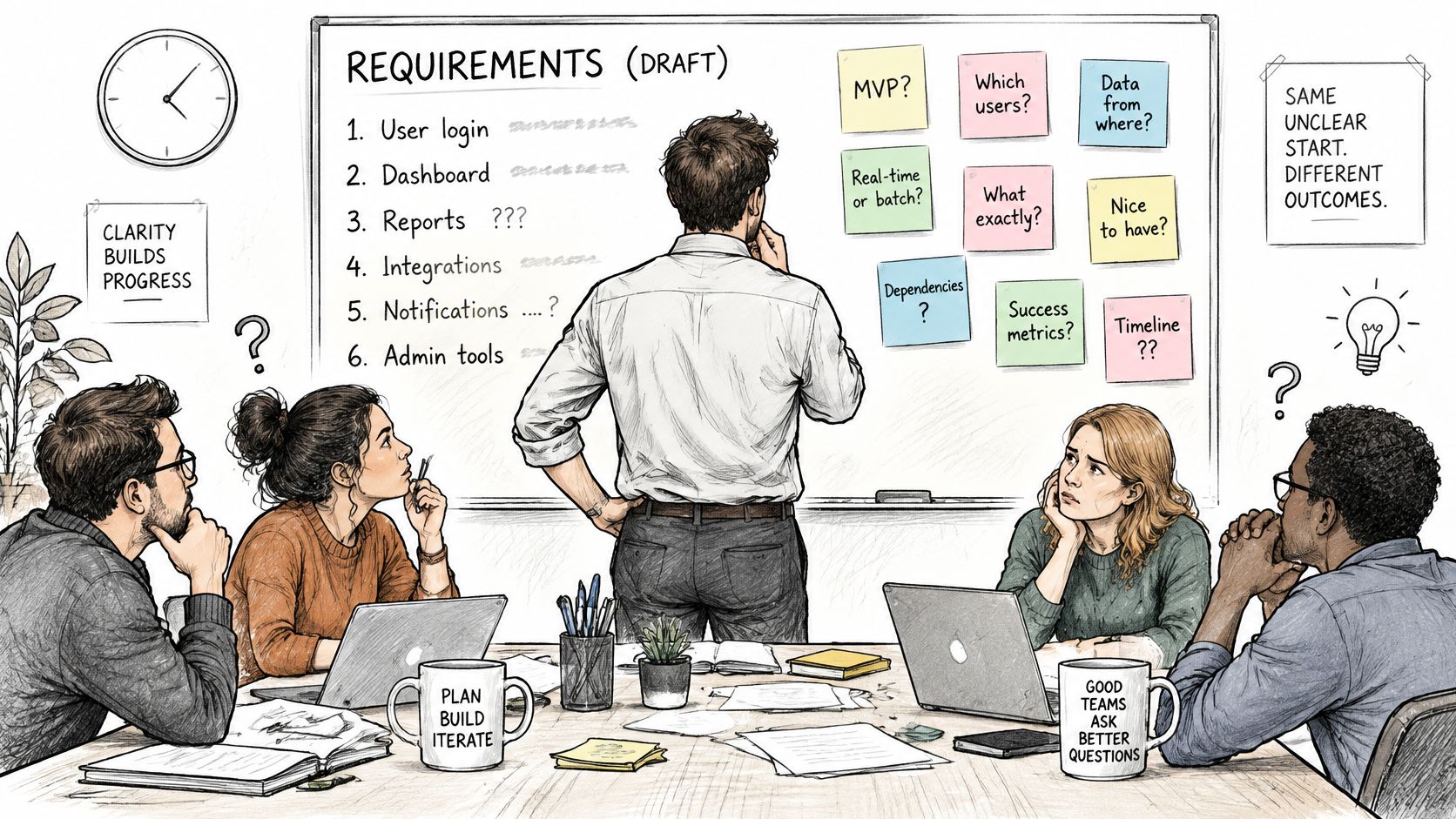
Six Steps From Conversation to Baseline
- Identify every stakeholder. List who approves, funds, uses, or is affected by the outcome. The typical mistake is interviewing the sponsor and missing the reviewer who'll reject the work later.
- Collect source inputs. Pull the contract, business case, drawings or specifications, budget limits, and regulatory constraints into one place. If inputs conflict, record the conflict instead of picking a favorite.
- Draft each requirement as a checkable statement. Attach a number, date, or condition. "Fast turnaround" isn't testable. "Submittal review returned within five business days" is.
- Test for ambiguity. Ask how a reviewer would confirm the requirement was met. If two competent people would check it differently, rewrite it until they wouldn't.
- Record assumptions separately. Give each assumption an owner and a date to confirm it. Assumptions buried inside scope statements become unpriced change later.
- Get written sign off and freeze the version. That frozen version becomes the baseline. Everything after it is a change, not a clarification.
Step three is where teams slip most often. Words like high quality, complete, and as needed sound professional and measure nothing. Replace them with the standard, tolerance, or acceptance rule you'll apply at review.

Practical rule: If a reviewer can't mark a requirement pass or fail without calling you first, it isn't finished yet.
A worked example helps more than a blank template when you're drafting your first version. Projectify publishes a filled project brief example that shows how scope, deliverables, and constraints look when they're written as concrete entries rather than headings. Use that level of specificity as your floor, then adapt the fields to your contract and sector.
When You Cannot Baseline Yet
Sometimes the scope is unknown. An existing conditions survey, a payer workflow audit, or a systems discovery may need to happen before anyone can price the actual work. Don't force a fixed baseline in that situation.
Run a discovery phase with a defined output, a fixed duration, and a named decision at the end. State in writing that the baseline will be reissued after discovery. That's honest control. Pretending uncertainty is certainty is how contingency disappears in month one.
Skills Project Managers Need to Meet Requirements
A project manager needs two different kinds of skill, and confusing them produces bad hires. Control skills keep requirements intact. They include writing testable statements, maintaining a logic linked schedule, pricing change before approval, and keeping records current. Domain skills let the manager judge whether a requirement makes technical sense in the first place.
Strong software experience doesn't guarantee either one. A manager can be fluent in Procore, Buildertrend, or Monday and still let a change log drift for three weeks. I would test the work directly. Our practical test for project managers is a schedule or RFI exercise, because it shows judgment under realistic pressure instead of vocabulary recall. You can see how that role is scoped in our project management specialist hiring overview.
| Skill | What It Looks Like on the Job | How to Test It |
|---|---|---|
| Requirements elicitation | Interviews stakeholders and turns answers into testable statements | Rewrite three vague requests as measurable requirements |
| Scheduling | Builds a logic-linked baseline and updates it with actual progress | Update a sample schedule after a two-week delay and explain the float impact |
| Cost control | Tracks commitments, forecasts and contingency use | Reconcile a sample cost report against the approved budget |
| Risk management | Identifies risks, owners and response dates | Prepare a five-item risk register from a short project brief |
| Document control | Keeps versions, logs and approvals traceable | Build an RFI log with due dates from sample correspondence |
| Stakeholder communication | Adjusts reporting for sponsors, designers and contractors | Draft a two-paragraph status update from a sample status sheet |
Certification and Domain Knowledge
Treat PMP or similar certification as one signal among several. It shows structured training and commitment. It doesn't replace evidence of work on projects similar to yours, at similar size, under similar contract pressure.
Domain weight rises in architecture, engineering, and construction. A manager should understand the drawing set, the permit sequence, and the code references shaping decisions. Our remote professionals have worked on US projects and understand US construction methods, imperial units, CSI divisions and IBC/IRC requirements, which matters when a requirement references a sheet, a division, or a code driven detail.
Medical practices face the same split. An administrator leading an EHR rollout needs workflow knowledge and a clear view of which tasks require licensed staff. Administrative support can coordinate training schedules, track build decisions, and chase sign offs. It shouldn't independently make clinical workflow decisions.
Test each candidate on the work they'll do. General project vocabulary is cheap. A clean RFI log built from messy correspondence is evidence.
Documentation and Traceability Requirements
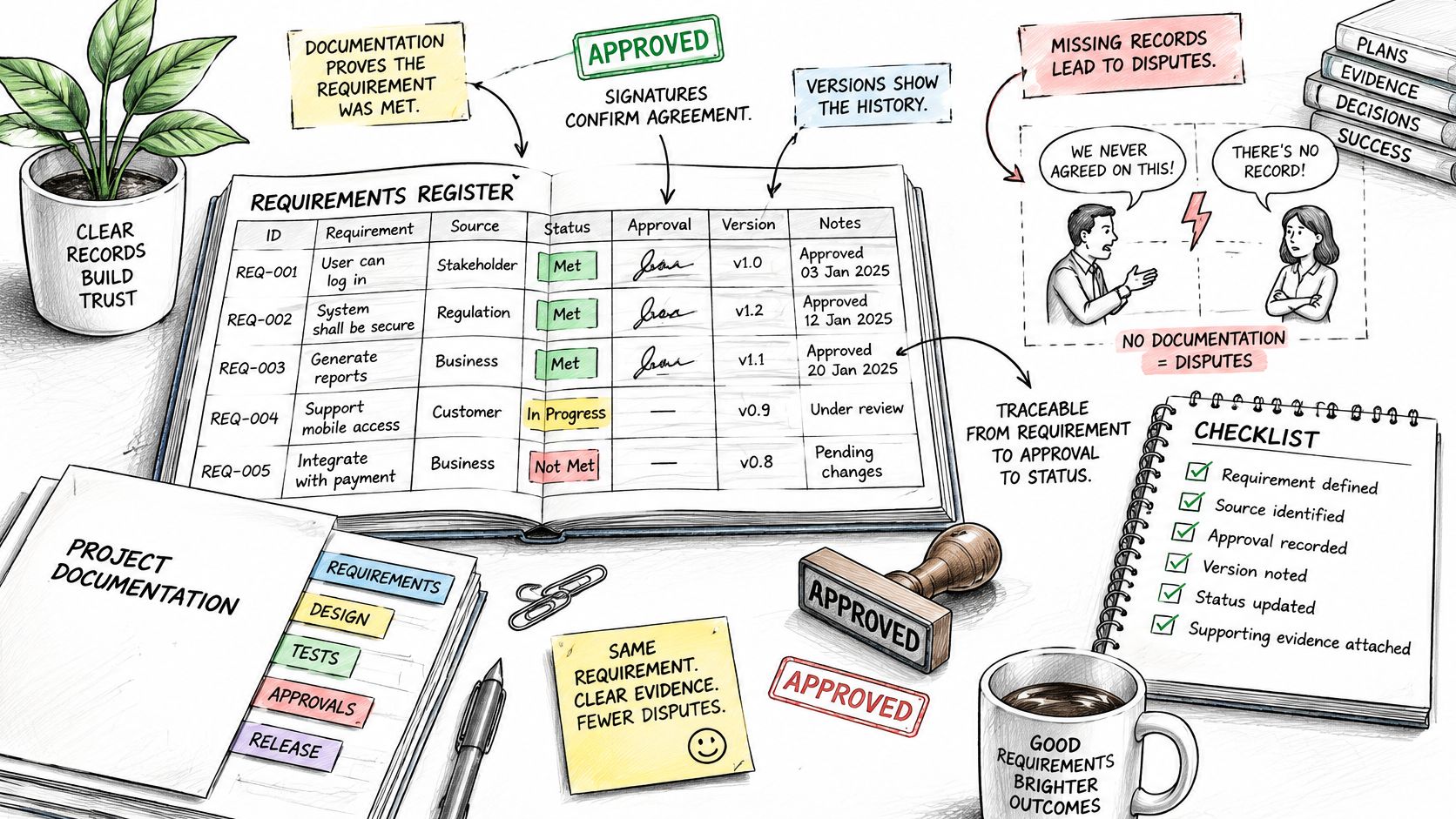
Most disputes don't start because the work was wrong. They start because the record proving the work met the requirement is missing, misnamed, or sitting in someone's inbox. Documentation is how you prove compliance months later, when memories have moved on and the sponsor asks a fair question you can't answer.
Take one requirement and trace it. "The stair layout meets the code required rise and run" should link to a drawing sheet showing the dimensions, a review comment confirming the check, and a closing approval from the responsible reviewer. If any link in that chain is missing, you have an assertion, not traceability.
Core Records Worth Maintaining
- Requirements register: Each item gets a unique identifier, owner, source, and acceptance method.
- Decision log: Record the decision, date, decision maker, and documents affected.
- Meeting minutes: Capture decisions and owners, not a transcript of discussion.
- Submittal and RFI logs: Track due dates, responsible reviewers, status, and cost or schedule impact.
- Version controlled document set: One source location, clear revision status, and controlled access.
Firms setting up these systems often start with a defined set of project management documents and templates rather than inventing every log from scratch. The template matters less than consistent use. A simple tracker updated weekly beats a detailed register nobody touches.
The ISO 19650 standard for managing information over the life cycle of a built asset requires project information to be systematically exchanged, recorded, versioned, and organized across participants. Treat it as a standard to adapt to your project size, not as a legal requirement in most places. Its useful lesson is simple. A deliverable isn't just a file. It's an approved information exchange with status, revision history, and accountable ownership.
Medical practices need the same discipline in a different filing cabinet. If credentialing and payer enrollment files live in a shared folder, link each requirement, such as a current license copy or payer approval letter, to the file that proves it. Where records contain protected health information, HIPAA Security Rule obligations published by HHS apply. File naming and tracker rules are recommended practice rather than HIPAA mandates, and there's no official HIPAA certification from HHS, so keep legal obligations and internal good practice distinct in your policy.
A small team can run all records in one shared tracker. That works if naming, access, and review rules are written down. It fails when "Final_v7_REAL" becomes your version control system.
Governance, Decision Rights and Change Control
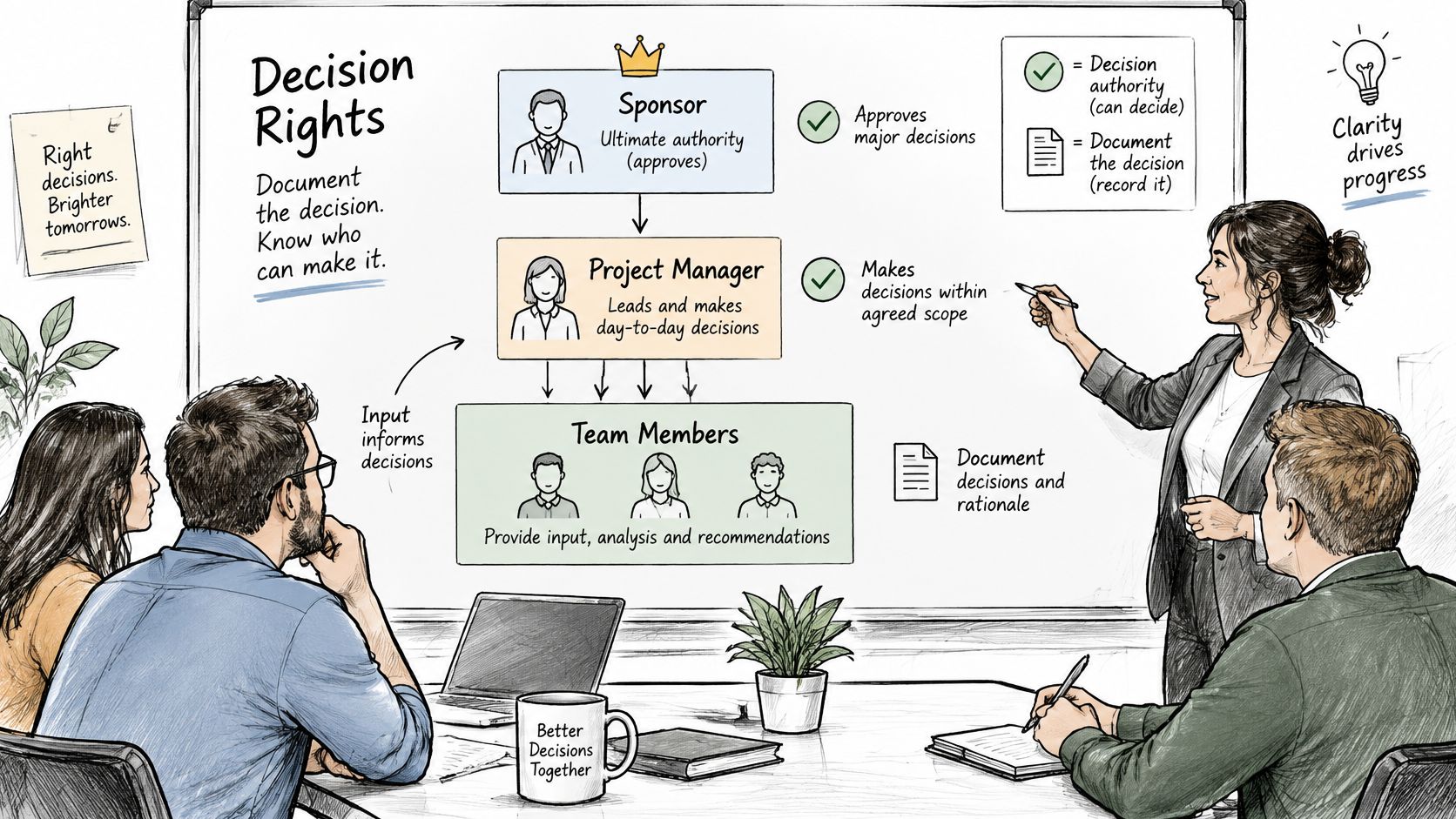
Documenting a decision isn't the same as having authority to make it. That confusion sits behind a lot of unapproved work. A coordinator routes an item, a designer answers a question, a contractor proceeds in good faith, and only later does someone ask who authorized the cost.
A Simple Decision Rights Grid
Write down three tiers before production starts. The sponsor decides scope, budget, and major schedule changes. The project manager may approve routine items within a stated limit, such as resequencing work that doesn't move a milestone. The technical lead or external reviewer decides technical compliance within their discipline. If a decision doesn't fit a tier, it escalates. It doesn't get improvised.
Change control then follows a fixed sequence. Log the request, assess its effect on scope, cost, and schedule, route it to the decision owner, record the outcome, and update the baseline only after approval. Skipping the assessment step is the expensive shortcut. Leaders who want a broader view of keeping leadership priorities aligned with delivery will recognize the same pattern at portfolio level, where unpriced requests consume capacity.
The evidence supports treating this as an operational control, not paperwork. A Construction Industry Institute analysis of 77 projects associated high implementation of recommended practices with approximately 8% better cost outcomes than low implementation. Present that as an association, not a guarantee for your project. It still tells you disciplined change and risk practices correlate with money saved.
An RFI answer clarifies the work. It does not, by itself, authorize extra cost or time.
That boundary is explicit in AIA G716 RFI guidance, which states the RFI request and response do not authorize work that increases project cost or time. A remote coordinator can log the RFI, check references and attachments, route it, and chase the due date. Approval of extra work stays with the contract authority.
Set escalation thresholds the sponsor chooses in advance. Examples include an unresolved item threatening a critical path activity, or a proposed change that would consume contingency beyond a stated limit. More approval gates protect control but slow small projects, so match the number of gates to the financial exposure, not to habit.
Common Requirement Gaps and How to Fix Them
Scope disputes are the symptom teams notice first because they arrive with an invoice attached. Two parties argue about whether coordination, revisions, or a permit resubmission was included. Underneath, the exclusions were never written down. Start diagnosis from what you can see, then trace it to the missing project management requirements behind it.
Diagnose From Symptom to Cause
| Symptom | Likely Requirement Gap | Fix |
|---|---|---|
| Repeated scope disputes | Scope exclusions were never written down | Add an exclusions list and get sponsor sign-off |
| Late approvals | No named approver or review deadline | Add approver and due date to the responsibility matrix |
| Cost overruns without warning | Change requests are not priced before approval | Require a cost and schedule impact statement on every change request |
| Conflicting file versions | No naming or revision rules | Set a naming convention and a single source location |
| Overdue RFIs | No reply date or escalation rule | Set a reply date and an escalation threshold on each RFI |
| Rework after handoff | Deliverable standards are undefined | Attach a standards list and acceptance criteria to each deliverable |
Fix approval gaps and missing exclusions first. They generate the most downstream disputes because they affect money, authority, and trust at the same time. A late approval on a long lead item doesn't just move a date. It can force expedited procurement, resequence trades, or push a practice opening.
Naming and version rules come next because they're cheap to set up and painful to retrofit. One afternoon spent defining file names, revision codes, and a single source location prevents weeks of "which set did you price from" confusion. Undefined deliverable standards deserve the same urgency on handoff heavy work, where a receiving team can't use what it can't verify.
Don't add every control at once. That's the trade off teams underestimate. Each new log, gate, and report consumes real hours, and a small firm that adopts a large project control system wholesale will abandon it by week three.
- Week one priority: Add the exclusions list, named approvers, and review deadlines.
- Next review cycle: Require impact statements on changes and reply dates on RFIs.
- Following cycle: Tighten naming rules and attach acceptance criteria to deliverables.
Confirm a fix worked by watching the next two reporting cycles. Did the same symptom recur? Does the record that should have prevented it now exist, and is someone using it? If the log exists but stays empty, you fixed the template, not the requirement.
The Takeaway
Project management requirements work when they're treated as operational controls with named owners, records, and decision rights. They fail when they're treated as a kickoff document that gets filed and forgotten. Written, versioned, and agreed before work begins isn't bureaucracy. It's the cheapest risk control you own.
Before you start, run this checklist:
- Scope signed: The scope statement and exclusions carry sponsor sign off.
- Deliverables defined: Every deliverable has a standard and an acceptance rule.
- Baselines set: The schedule and budget include named milestones and contingency.
- Approvals named: Each role has a reviewer and an approval deadline.
- Change path written: The team knows the change control route and escalation thresholds.
- Records ready: Naming rules, logs, and storage location exist before production begins.
Don't start on a no to items 1, 2, or 5. Items 3 and 6 can be completed during the first two weeks if the sponsor accepts that risk in writing. Requirements vary by contract, jurisdiction, and sector, so confirm your obligations with qualified counsel or a compliance professional.
If your practice needs remote support for records and coordination, Medical Virtual Assistants can share a shortlist of pre vetted, bilingual candidates within 24 hours, and you interview before you hire.
If your firm needs a remote project manager to maintain schedules, RFIs, submittals, and change logs inside your existing systems while your senior staff keep approval authority, we can help you scope the role and test candidates on the actual work. Visit HireArchitects to start with a short call about your project management requirements, software, and hours.