
Your contractor says the work is on schedule, the architect is waiting for answers, and the latest cost report doesn't include pending changes. Meanwhile, you're trying to decide whether to hire another coordinator or bring in outside help. Project management advisors are useful when someone needs to establish reliable project controls, explain what the records actually show, and get unresolved decisions in front of the right people.
An advisor sets up and maintains the schedule, coordination logs, change records, forecasts, and reporting that support project decisions. The advisor doesn't automatically inherit the owner's authority, the contractor's field responsibilities, or the designer's professional obligations. That distinction matters whether you're running a construction firm, managing a design practice, or overseeing a medical-office expansion while keeping patient operations running.
The hiring decision should start with the problem, not the title. Missing information calls for better records. An unreliable completion date calls for schedule diagnosis. Slow approvals call for clearer decision rights. More staff can help with workload, but they won't resolve an owner's unwillingness to decide or a schedule built on unsupported assumptions.
The strongest engagement gives you something usable: a credible forecast, a visible list of decisions, and project records your firm can retain after the advisor leaves. Software proficiency matters, but authority, schedule reliability, and record ownership determine whether that proficiency produces useful work.
What Project Management Advisors Actually Do
A project management advisor establishes and runs the control systems around a project while the owner, contractor, and design team retain their assigned decisions and responsibilities. Those systems connect planned work to actual progress, identify missing information, and explain the likely consequences of unresolved issues.
The discipline grew from structured scheduling rather than general administrative assistance. The Project Management Institute's history traces foundational developments including CPM in 1957, PERT in 1958, and PMI's founding in 1969. The practical inheritance is dependency-based planning: work has prerequisites, milestones require evidence, and changes need a traceable effect on time and cost.

The recurring work behind the title
An advisor's routine scope usually includes:
- Master schedule maintenance. Collect progress updates, review dependencies, and distinguish the approved baseline from the current forecast.
- RFI, submittal, and decision tracking. Identify unanswered questions, outstanding reviews, and approvals that could prevent planned work.
- Change-order administration. Assemble instructions, quotations, supporting correspondence, and stated schedule effects without treating an unapproved request as an approved commitment.
- Cost and schedule forecasting. Explain what pending changes, procurement risks, and production trends mean for the expected outcome.
- Subcontractor follow-up and coordination. Prepare meetings around unresolved commitments and record who agreed to do what.
- Closeout documentation. Organize warranties, operation manuals, testing records, outstanding deficiencies, and turnover requirements.
These functions require judgment. Forwarding an overdue request isn't the same as identifying that its answer controls fabrication release. A useful advisor connects the record to the work it affects and presents a decision the responsible person can act on.
What remains outside the role
Advisors generally don't sign or seal drawings, replace the architect or engineer of record, direct trade crews, or approve payments unless their agreement expressly grants an applicable authority. Even an experienced advisor can recommend a response without having permission to issue it.
For a medical practice renovating occupied space, the advisor might coordinate shutdown proposals and flag a conflict with clinic hours. Practice leadership still decides what operational disruption is acceptable, while qualified construction and design personnel determine how the work should be performed.

Scope test: Ask for a one-page document naming each deliverable, its approver, and the system where the accepted record will live.
That test separates a defined advisory assignment from an open-ended promise to keep the project moving. It also exposes gaps before you pay someone to discover that nobody can approve their recommendations.
Advisor Versus In-House Project Management Compared
Advisor and in-house project management by decision criterion
| Criterion | In-house project manager | Outside advisor |
|---|---|---|
| Cost structure | Salary, benefits, overhead, and training carried year-round | Fee tied to scope or time; no employee benefits obligation, with unused capacity governed by the agreement |
| Decision authority | Line authority over assigned staff and schedule decisions within company policy | Advisory role unless the contract grants specific decision rights |
| Continuity of knowledge | Builds firm-specific judgment and institutional memory | Knowledge can leave with the advisor unless records and reasoning are documented |
| Ramp-up time | Must learn the firm's people, systems, and standards | Can establish standard controls promptly after receiving access and a proper briefing |
| Capacity flexibility | Fixed headcount that's harder to reduce between projects | Capacity can align with phases, workload peaks, or a defined recovery assignment |
| Accountability for outcomes | Managed through assigned duties and performance review | Defined by contract scope, acceptance criteria, and engagement responsibilities |
| Best fit | Steady workload across active projects | Peaks, recovery work, specialized phases, or an independent second look |
The comparison is a decision aid, not a verdict. An employed manager can recognize which subcontractor needs closer follow-up, how a principal expects risks presented, and which internal commitments are realistic. An outside advisor must learn those relationships or work from records that make them explicit.
Compare the whole cost, not the hourly rate
For an employed manager, loaded cost includes salary, benefits, payroll taxes, software, training, supervision, and paid capacity that isn't assigned to productive project work. For an advisor, include the fee, onboarding effort, internal review time, required licenses, and any charges for work outside the agreed scope.
A short engagement can look expensive by the hour and still be economical if it resolves a consequential procurement or turnover problem. Conversely, a modest recurring fee can become poor value when the advisor spends most of the engagement requesting information your team never supplies.
For a medical practice with an occasional buildout, permanent construction-management headcount may not make sense. A contractor delivering a steady portfolio has a different need: someone must retain lessons, maintain standards, and supervise controls between outside assignments.
Continuity and independence pull in different directions
An outside reviewer can challenge assumptions without defending the original plan. That independence is useful during recovery, but it doesn't replace institutional knowledge. Require editable files, documented assumptions, and a handover process so the advisor's reasoning remains available.
The models aren't mutually exclusive. You can retain an internal controls lead and use an advisor for schedule recovery, preconstruction setup, or a demanding closeout period.
Keep responsibility for the control system inside the firm, even when someone outside the firm operates parts of it.
The right balance reflects how much work is recurring and how much decision authority leadership is prepared to delegate. Don't use an advisory contract to avoid appointing an accountable internal sponsor.
Situations That Call for an Outside Advisor
The search often starts when project administration competes with delivery. A superintendent is answering field questions while change documentation accumulates, or an owner receives reports but can't tell which decision threatens occupancy. Outside support earns its place when it addresses a defined gap rather than adding another reporting layer.
Where the engagement can be useful
- Field leadership can't maintain the records. Say a contractor has concurrent projects and its superintendents can't keep RFI and change documentation current. An advisor can maintain the administrative controls while field leaders verify progress and direct execution.
- The owner lacks construction staff. A medical practice undertaking a design-build expansion may need someone to interpret the schedule, organize decisions, and distinguish construction completion from readiness to receive patients.
- Leadership needs an independent recovery assessment. On a stalled commercial project, an advisor can examine the schedule and supporting records before management reassigns staff or accepts a revised completion date.
- The firm is taking on more complex work. A remodeler entering multifamily construction may need consistent procurement, submittal, and change controls rather than a collection of personal spreadsheets.
- Records need organizing for a potential claim. An advisor can assemble contemporaneous schedules, instructions, and correspondence. Counsel should direct legal strategy and advise on handling sensitive material.
Timing matters. Establishing responsibilities before procurement starts is easier than reconstructing commitments after equipment arrives late. Reviewing preconstruction team roles and responsibilities can also reveal that you need an estimator, scheduler, or design coordinator rather than a broad advisory assignment.
When another solution is better
A capable in-house coordinator may be sufficient for a small, straightforward project. Hiring an advisor is difficult to justify when the assignment is merely keeping an uncomplicated action list current.
Outside support is also the wrong answer when leadership won't provide access, respond to escalations, or acknowledge responsibility for decisions. An advisor can document an overdue owner selection, but can't legitimately make that selection just to preserve the schedule.
Licensed work is another boundary. If the problem requires engineering analysis or professional design approval, engage the appropriately qualified professional rather than expanding an administrative scope.
Before engaging anyone, answer these questions in writing:
- Report recipient. Who will review the advisor's findings and act on them?
- Decision permission. What may the advisor decide without further approval?
- Unaccepted advice. Who records the decision and resulting forecast when leadership chooses another course?
Those answers determine whether the engagement has an operating purpose or merely produces documentation.
Controls an Advisor Should Put in Place Early
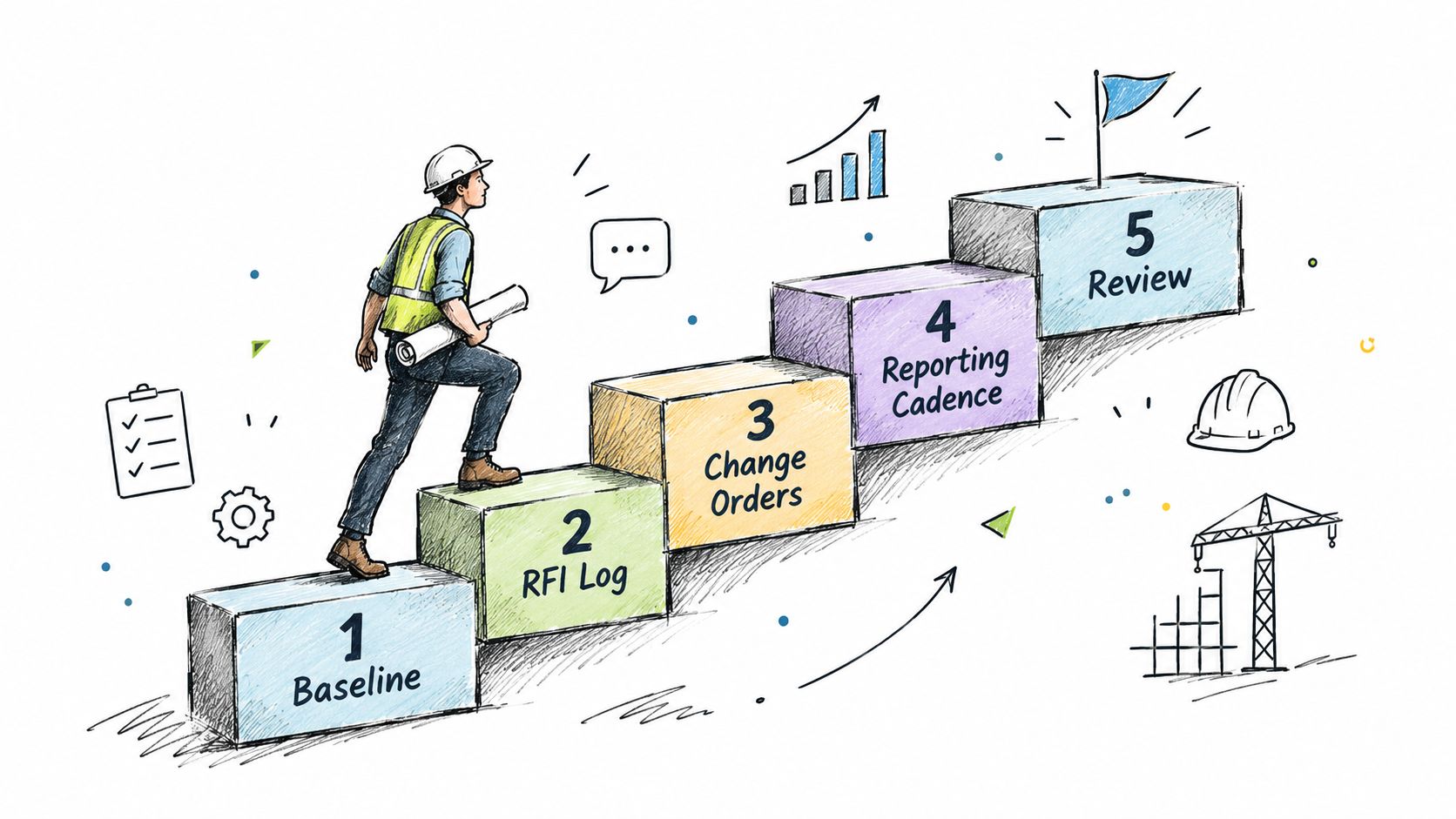
Start with a control cadence, not a software purchase. The team needs an agreed method for collecting facts, reviewing exceptions, and making decisions before major execution begins.
McKinsey's construction productivity analysis, drawing on more than $1 trillion in capital projects, identified improvements in basic project-management practices as the greatest opportunity for better site performance and recommended production measures alongside conventional earned-value reporting. The useful lesson for a smaller project is methodological: monitor what teams are producing, not just how the summary chart looks.
Establish the controls in working order
- Approve a baseline schedule. Have the people performing the work review dependencies, durations, access assumptions, and procurement requirements. A date accepted without that review is a target, not a reliable execution plan.
- Build a responsibility matrix. Name an owner and approver for each decision and deliverable. Separate preparing a recommendation from authorizing it.
- Open procurement and submittal registers. Connect required-on-site dates to review, fabrication, and delivery activities. Recording only the promised delivery date conceals the approvals needed to achieve it.
- Track RFI aging. Assign response targets that reflect when the answer is needed for work. Flag the affected activity so an overdue technical question doesn't remain an isolated administrative item.
- Maintain a linked change-order log. Keep the instruction, proposed value, approval status, and schedule effect together. Distinguish pending exposure from authorized budget changes.
- Run a weekly variance review. Compare forecast outcomes with the baseline and assign corrective actions. Explain causes rather than repeatedly moving dates until the report appears current.
Put physical production beside financial progress
Earned-value curves can summarize performance without revealing the obstruction that needs attention. Track drawings reviewed, RFIs closed, submittals approved, and installed quantities alongside cost and schedule summaries.
Interpret these measures carefully. Closing easy RFIs doesn't compensate for leaving a fabrication-critical question unanswered, and a reviewed submittal isn't necessarily released for purchase. The advisor should identify whether the completed administrative work actually permits the next production activity.
For an occupied medical-office renovation, connect construction activities to access windows and operational approvals. A forecast that assumes unrestricted access won't help the practice manager protect patient appointments.
Use the client's designated platform as the authoritative record, with an owner and due date on each action. Escalate forecast variance while leadership still has choices.
Reporting discipline: Keep the detailed registers available, but put the decisions requiring action at the front of the review.
A small renovation may need only a monthly formal review, supplemented by immediate escalation of urgent issues. Reporting effort should match exposure; excessive administration can bury the issues that matter.
Diagnosing Schedule Failure Before Adding Resources
Adding a coordinator to an unreliable schedule can produce more frequent updates without producing a more credible completion date. Before increasing headcount, establish whether the team has a workload problem, a planning problem, or a decision bottleneck.
A 2025 analysis of tens of thousands of critical-path-method schedules, summarized by Construction Owners, reported that over 70% of projects in its dataset missed schedule targets and had a Schedule Performance Index below 0.90. The same account identifies ineffective communication, inadequate project management, and poor documentation as construction-conflict sources discussed by the Construction Management Association of America. These findings justify investigation, not a blanket conclusion about your project.
Follow the symptoms to the records
Schedule symptoms, likely causes and first checks
| Symptom | Likely root cause | First check |
|---|---|---|
| Float shrinks or disappears across successive updates | Logic changes or hard-coded constraints | Compare logic and constraint edits between successive updates |
| Milestones slip while activities report on time | Progress recorded as percent complete, not physical work | Field-verify completed quantities against reported progress |
| RFIs and submittals older than the schedule allows | Owner or design decision latency | Age open items by responsible party and required decision date |
| Late design changes during construction | Coordination not closed before the design freeze | Check open clashes and unresolved design items against the freeze date |
| Cost forecast drifting while the schedule looks stable | Earned value masking a production slowdown | Compare production rates against planned quantities |
| Many activities with no predecessors or successors | Dangling activities that break the critical path | Run a logic check for open starts and open finishes |
These are diagnostic starting points, not automatic findings. Float can also change because actual progress differs from the plan, and a cost forecast can deteriorate for reasons unrelated to production. The advisor must test the explanation against source records.
Start by comparing schedule versions. Review changed relationships, imposed dates, calendars, and remaining durations; ask why each consequential edit was made. Hard constraints can be legitimate, but they shouldn't substitute for showing the actual dependencies that lead to a milestone.
Verify the updates before prescribing capacity
Next, reconcile progress with field evidence. Percent complete is weak evidence when nobody can explain the installed quantity, completed area, or acceptance condition behind it.
Then examine decision latency. Separate time waiting for an owner's choice from time waiting for technical review, and identify whether change instructions have been incorporated into the forecast. Otherwise, the team may blame field capacity for work it hasn't been authorized or equipped to perform.
For a practice awaiting turnover, a nearly complete reception area doesn't prove that testing, equipment installation, and operational preparation can finish as forecast. Assess those dependencies explicitly.
If this requires specialist support, construction scheduling assistance should be scoped around logic review, update discipline, and forecast reconciliation, rather than just producing a cleaner chart.
Add staff when the planning logic, records, and decision process are sound but the remaining workload exceeds available capacity. That's a defensible staffing decision because you can identify the work the additional person will complete.
Where BIM and AI Help and Where They Add Risk
Technology readiness is uneven. The 2025 RICS global AI-in-construction findings reported 45% of organizations using no AI and only 1% scaling it across projects, with barriers including skilled personnel (46%), system integration (37%), and data quality (30%); nevertheless, nearly 70% of project managers and quantity surveyors expected AI to help them deliver greater value.
That gap makes governance a practical advisory responsibility. A forecast generated from inconsistent records isn't dependable merely because the software produces it quickly.

Reconcile information before automating it
Say a midsized contractor's estimate uses different work packages from its schedule, while the document register lists superseded drawings as current. The advisor's initial assignment should reconcile identifiers, versions, and approval status rather than select another application.
Before introducing AI, define:
- Permitted inputs. Identify which records may enter the tool and confirm applicable confidentiality and ownership terms.
- Human review. Assign a qualified reviewer to check outputs against source documents and project assumptions.
- Decision responsibility. Keep forecast acceptance and contractual decisions with named people.
- Audit records. Retain the source version, output, corrections, and approval needed to explain consequential recommendations.
For healthcare owners, keep patient information outside construction workflows unless there's a justified, reviewed need. Confirm privacy and security obligations with qualified compliance professionals rather than assuming a general collaboration tool is appropriate.
Use BIM to verify coordination closure
Building information modeling, or BIM, becomes a controls tool when clash-resolution status, drawing-review throughput, and approved model milestones connect to the master schedule. A resolved model issue is useful only if the resolution reaches released documents and field work.
The handoff between BIM coordination support and project controls should identify the responsible reviewer, affected package, release condition, and schedule activity. Don't treat a clash count as proof that construction information is ready.
Integration effort, training, and vendor-specific file formats all affect the decision. A disciplined register and clear approval workflow may be preferable to automation when the process is unstable or the team can't support another system.
Confirm the Scope and Costs Before You Hire
Write the one-page scope before interviewing candidates. It gives you a consistent basis for comparing advisory proposals, employed managers, and remote project support without confusing different levels of responsibility.
Put the operating agreement in writing
- Decision rights. State what the advisor may recommend, issue, or approve.
- Deliverables and cadence. Define the schedule update, exception report, registers, and review meetings.
- Systems and access. Identify platforms, permissions, and the person who grants access.
- Record ownership. Require editable files, supporting correspondence, and a usable handover.
- Escalation rules. Name recipients and response expectations for unresolved matters.
- Working-hour overlap. Specify attendance at site calls, owner meetings, and coordination reviews.
- Software licenses. Allocate responsibility for subscriptions and authorized use.
- Trial outputs. Set measurable acceptance criteria, such as a reconciled schedule update or an accurately maintained RFI register.
A trial should test judgment as well as formatting. Give the candidate an incomplete record and evaluate whether they identify assumptions, flag missing evidence, and avoid presenting an unsupported conclusion as fact.
Compare the same scope on both sides
The U.S. Bureau of Labor Statistics reports a median annual wage of $102,320 for U.S. project management specialists in May 2025. That's a wage benchmark, not a loaded employment cost or an advisor's fee schedule.
Compare the actual assignment, supervision burden, and consequences of delayed work. Don't compare a full-time manager responsible for a portfolio with an advisor maintaining a limited set of registers.
Remote support is practical when the work is digital and field verification remains assigned locally. At HireArchitects, our project managers can work inside Procore, Buildertrend, and Monday; our remote professionals usually keep full U.S. business hours so they can join meetings, bid reviews, and site calls live.
Our intake process uses a 20-minute call to define the role, software, and required hours, and the practical assessment for project managers is a schedule or RFI exercise. Most firms provide the software licenses their remote hire needs.
Confirm time-zone coordination, data-security expectations, contract terms, and insurance requirements before work begins. Qualified counsel should review legal responsibility and risk allocation; remote access doesn't eliminate either.
The Takeaway
Project management advisors add value when they make project information reliable and decisions actionable. They're not a substitute for accountable leadership, licensed design services, or competent field supervision. Hire against a defined control problem rather than a broad promise of better coordination.
Write the one-page scope this week and use it in every hiring conversation. Evaluate candidates on how they test assumptions, handle incomplete records, and explain the decision required, then retain the records and reasoning your firm needs to operate without them.
HireArchitects connects U.S. architecture, engineering, and construction firms with vetted remote professionals from Latin America, including project management support. Visit HireArchitects with your draft scope to discuss the role, software, and working hours your project requires.