In the Associated General Contractors of America's 2025 Workforce Survey, 45% of respondents said labor shortages affecting their own employees or subcontractors had caused project delays. Among firms hiring salaried staff, 77% said estimators were hard to fill and 76% said the same of project managers and supervisors. The roles that run the controls are the hardest roles to hire, which is precisely why the controls can't live in one experienced manager's head.
A project management process is the set of decisions, documents, and checkpoints that turns interdependent work into a delivery system you can measure. The five stages (initiation, planning, execution, monitoring and controlling, closing) are only the skeleton. What holds a schedule together is duller: an approved baseline, a change log with money attached, an RFI register with names and dates, and a closeout package a stranger can read a year later.
Control rarely slips in a dramatic way. It slips in small unrecorded decisions: a verbal scope change, a question that sat in an inbox for nine days, a baseline nobody signed. Below, each stage gets the question it answers, the work inside it, and the output that proves it's done, along with the delivery-method decision, the ownership split, and the breakdowns that cost the most time.
The Five Stages at a Glance
Each stage answers exactly one question, and each answer leaves a document behind. That's the useful version of the diagram, because it converts a picture into something you can audit at any point in the job.
| Stage | Main question | Core activities | Output that proves completion |
|---|---|---|---|
| Initiation | Should this work start? | Define purpose, sponsor, rough scope and budget range | Signed project charter and go or no-go decision |
| Planning | How will the work be delivered and measured? | Work breakdown structure, activity dependencies, durations, critical path, risk register | Approved baseline schedule, budget and risk register |
| Execution | Is the team doing the planned work? | Perform deliverables, manage RFIs, submittals and procurement, coordinate trades | Deliverables log and status records |
| Monitoring and controlling | Are schedule, cost and scope still on baseline? | Track variance, review changes, manage risks and issues | Variance reports and approved change log |
| Closing | Is the work accepted and recorded? | Verify deliverables, obtain acceptance, reconcile costs, archive records, review lessons | Closeout package and lessons-learned record |
Monitoring and controlling runs alongside execution, not after it. That's the most common misreading of every linear diagram in the trade. A steering meeting that reports percent complete without a variance figure against the approved baseline tells the sponsor nothing about whether the job is still deliverable.
What a Project Management Process Actually Controls
Firms and standards name the stages differently. PMI language, AIA design phases, and construction contract terms such as substantial completion all carve the same sequence of decisions into different shapes. The names matter less than the order: decide, plan, do, measure, accept.

The completion test I use: a stage is done when its output exists, a named person has accepted it, and the next stage can start without rework.
For a practice project, the same table applies. Adding two exam rooms to an existing suite asks at initiation whether the disruption to patient flow and scheduling is worth the revenue. At closing, the output becomes a go-live sign-off and a record of the workflows that were retired when the new EHR went live.
Teams that run projects inside a workspace tool can see the same logic mapped onto databases and status fields. NotionSender's project management walkthrough shows how stage gates, owners, and completion criteria translate into linked tables, which is a useful check on whether your process is documented or just remembered.
Choosing Predictive, Agile or Hybrid Methods
PMI's 2024 Pulse of the Profession report measured an average project-performance rate of 73.8% across survey respondents, and found that performance rates varied only marginally among predictive, agile, and hybrid approaches (PMI, Pulse of the Profession 2024). Read that as an average from a survey population, not a promise for your next buildout. The operational point is sharper: outcomes depend less on the label than on whether planning, coordination, measurement, and change control are applied consistently.
| Approach | Best fit | Main strength | Main limitation |
|---|---|---|---|
| Predictive | Fixed go-live dates, such as an EHR cutover or a buildout with permit milestones | Clear baseline for budget and schedule | Late discovery of workflow or design problems |
| Agile | Evolving requirements, such as testing a new patient-intake workflow in short cycles | Fast feedback and frequent review | Harder to fix budget and deadlines up front |
| Hybrid | Opening a new location with fixed milestones and iterative fit-out decisions | Fixed milestones with controlled iteration | Needs strict governance to avoid the weaknesses of both |
Three Questions That Settle the Choice
- How certain is the scope? If the exam-room count, the equipment list, and the go-live date are fixed by a lease or a permit, plan predictively and protect the baseline.
- How much change do you expect? A new intake workflow will change after the front desk uses it for two weeks. Short review cycles handle that better than a locked scope statement.
- Who must approve each milestone? If a landlord, an inspector, or a licensing body signs off at defined dates, those approvers decide the structure, not the team's preference.
Agile language applied to construction without a fixed milestone set and a budget ceiling is how cost control disappears. A team can iterate on reception finishes or signage. It cannot iterate on a permit submission date or a Certificate of Occupancy.
Whatever you choose, write the approach and its change rules into the charter, so the vendor, the clinical lead, and the sponsor are reading the same plan. An EHR cutover with a training window suits predictive planning. A patient-intake pilot suits short cycles. If you want to see how the three look once they're written down, browse example project plans that show the same scope under each structure before you commit.
How Initiation and Planning Set a Baseline
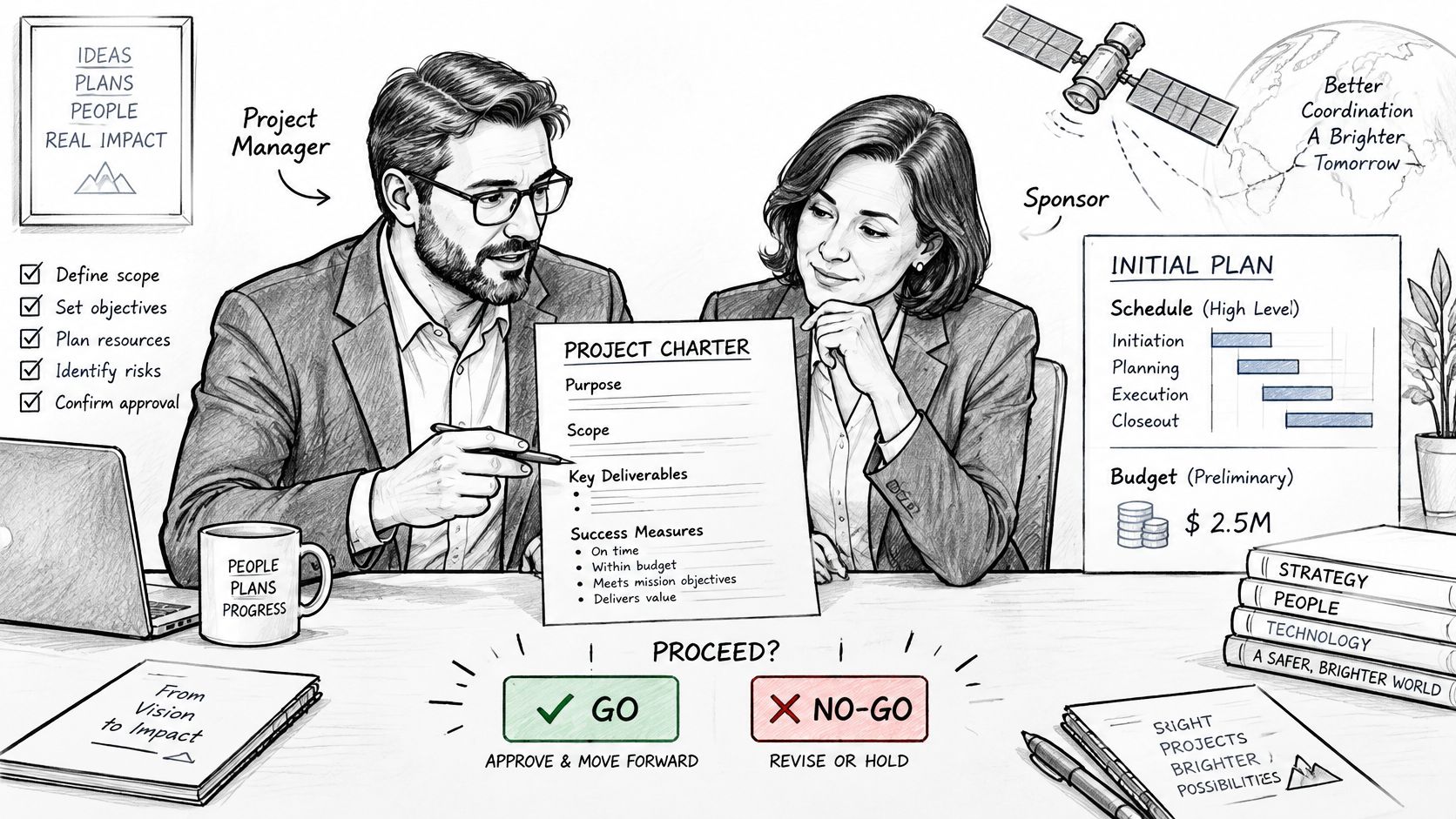
Initiation is one decision: should this work start at all. A short charter names the sponsor, the purpose, the rough budget range, and the measures of success, and it's approved before design hours or vendor deposits are spent. Say a nine-provider practice wants three more exam rooms. The charter states the revenue case, the disruption window, the sponsor, and the number that would make the project a no-go. Ten pages is too many. Two is usually enough.
The charter review is the cheapest meeting in the project. Once design fees and equipment orders start, the no-go option gets expensive, and teams start defending a decision instead of testing it.
Seven Planning Steps in the Order That Works
- Break the scope into deliverables. Your work breakdown structure for a fit-out looks like landlord approvals, plumbing and electrical rough-in, exam-room finishes, IT cabling, and equipment installation. Deliverables, not activities, go at this level.
- List the activities under each deliverable. Rough-in becomes demolition, framing, rough plumbing, electrical rough, and inspection. This is the level you can schedule and assign.
- Link the dependencies. Permit submission waits on final drawings. Equipment delivery waits on the finish schedule. A schedule without explicit dependencies is a wish list with dates.
- Estimate durations and name the resource. Who does the work matters as much as how long it takes, because a two-week task in a four-week backlog is a four-week task.
- Find the critical path. The Critical Path Method, developed by DuPont and Remington Rand for plant-maintenance work in the 1950s, calculates the longest chain of dependent activities and identifies the tasks with little or no float; PERT was built for the U.S. Navy's Polaris missile program to add uncertainty analysis, as the timeline of project management records. Gantt's horizontal bar chart from the 1910s is still the clearest way to show planned timing against actual progress.
- Record risks with an owner and a response. Not a list of worries. A named person, a trigger, and the planned response when the trigger fires.
- Get sponsor sign-off and freeze the baseline. Freeze it only after the landlord's approval date and the permit review window are locked, because a moving date at that point shifts the opening and every downstream deliverable with it.
A baseline you can change without a record isn't a baseline. It's a forecast, and forecasts never hold anyone accountable.
Later changes are logged with their cost and schedule impact, not overwritten in the file. A single-site job can survive on a spreadsheet with dependencies and a snapshot saved weekly. Multi-site or multi-vendor work needs scheduling software, and remote preconstruction coordinators can maintain the schedule, permit dates, and vendor tracker when your own team is buried in billable work.
Hold four documents before execution starts: the charter, the work breakdown structure, the approved baseline schedule and budget, and the risk register.
Keeping Execution on Track Through Monitoring and RFIs
Execution is where the plan meets site and design reality, so the process needs a routine rather than good intentions. The one I'd insist on is weekly: a status meeting tied to the schedule, a cost-to-date comparison against the budget, and a decision log recording who decided what and when. The log itself needs only four fields: date, decision, owner, and the document it changed. If the same item appears three weeks running with no decision recorded, that item is the status report.
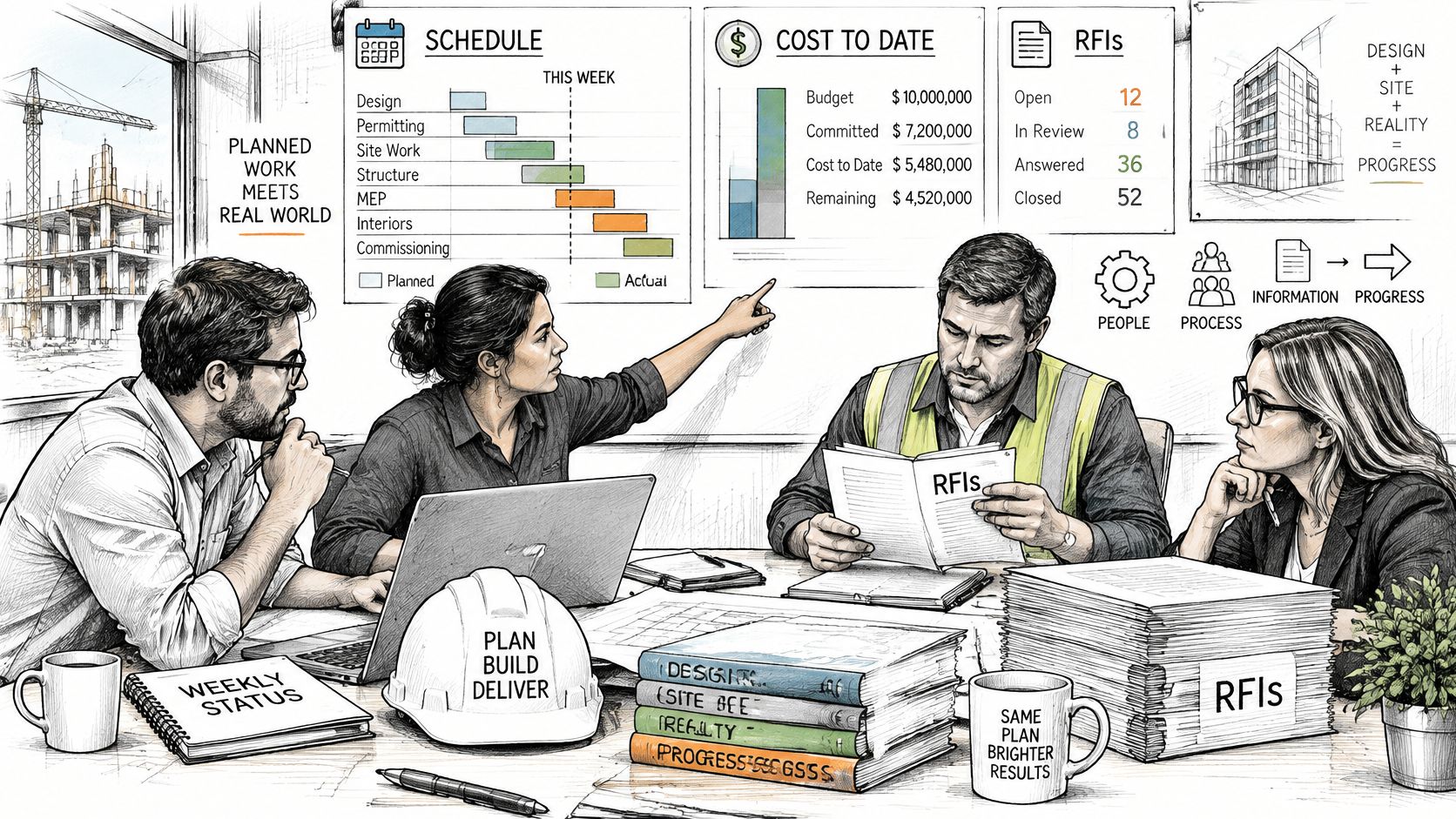
Benchmark data from 1,362 construction projects found that RFI creation typically peaks during roughly the first 10% to 30% of the project timeline, while the greatest number of open RFIs clusters around 30% to 50% completion, and the average time from opening an RFI to first response was 7.3 calendar days (Procore benchmark data). On a live job those numbers mean the open-question list grows fastest exactly when field work is heaviest, and each item can sit unanswered for about a week. The register, not the meeting, decides whether those items close.
The RFI Register That Makes Delay Visible
A register only earns its keep if every field is populated. Required fields are a unique identifier, the drawing or model reference, the responsible reviewer, the required-by date, priority, the affected activity, the proposed answer, the final disposition, and the cost or schedule impact.
An unanswered question on a critical-path activity doesn't pause the schedule. It moves the cost.
Two practices turn that list into control:
- Average response time by discipline. Electrical questions may clear in two days while structural ones take nine. The average tells you where to escalate, not who to blame.
- A critical-path flag on every open item. Any RFI attached to an activity with no float goes to the top of the reviewer's queue regardless of when it was opened.
Change control is the other half. Any change to scope, cost, or date gets logged, assessed, and approved before the work proceeds. Undocumented verbal changes are the standard source of disputes, and they're always hardest to price six months later.
Scale the tooling to the job. A small residential or single-suite job can run RFIs in a shared spreadsheet with one reviewer. A commercial project with several consultants needs document-control software, named reviewers per discipline, and a distribution rule so nobody discovers a decision by walking past it. Remote construction schedulers can keep the baseline schedule and float analysis current, while remote project managers maintain the register itself, chase late responses, and produce the weekly aging report sorted by days outstanding and reviewer.
Set a target for critical-path RFIs measured in working days, not weeks, and review aging items every week in the same meeting where you review cost.
Who Owns Each Stage in a Practice Project
Unclear ownership is what turns a routine question into a week's delay. Every stage needs a named decision owner, and that name goes in the charter, not in someone's memory of the kickoff call.
| Stage | Decision owner | Remote staff can support with | Stays with the practice or licensed professional |
|---|---|---|---|
| Initiation | Practice owner or sponsor | Drafting the charter summary and scoping notes | Go or no-go decision and budget approval |
| Planning | Practice manager | Building the task list and tracking vendor and permit dates | Clinical workflow sign-off and licensed design approvals |
| Execution | Practice manager or project manager | Logging RFIs and vendor submittals, scheduling site meetings | Answering clinical, code or licensing questions |
| Monitoring and controlling | Project manager | Updating status logs, cost-to-date reports and aging RFI lists | Approving scope or budget changes |
| Closing | Practice owner | Archiving records, compiling the closeout package, tracking warranty dates | Final acceptance and any regulatory sign-offs |
The split between remote-eligible and on-site work is real, and it's narrower than generally assumed on both sides. The American Institute of Architects reported that in 2024 only 17% of firms offered full-time remote work, while 70% of staff worked remotely at least some of the time (AIA). Document production, scheduling, and log maintenance travel well. Site observation, field verification, and professional sealing do not.
The test for delegation is whether a task can be checked against a document. If a reviewer can verify the output against the baseline, it can usually be handed off. If it requires professional judgment or a signature, it stays with the owner. Our remote project managers work inside Procore, Buildertrend, and Monday keeping RFI, submittal, and change logs current, while clinical, code, and licensing decisions remain with your team and your licensed professionals.
Closing Out a Project and Capturing Lessons
Closeout is where a lot of money leak out, because open items and unreconciled costs follow the project into its next phase and into someone else's budget line. The sequence that works is unglamorous:
- Verify each deliverable against the approved scope, line by line, not against what the team remembers promising.
- Obtain formal written acceptance from the sponsor or client, in a document you can file.
- Close or reassign every open RFI and submittal, so nothing is inherited by a maintenance contract by default.
- Reconcile final costs and approved change orders against the budget, and explain any variance in writing.
- Archive drawings, models, and correspondence with consistent file names and revision records.
- Hold a lessons-learned review within about 30 days, while people still remember why the schedule moved.
Take a commercial tenant fit-out that reaches handover with 14 open RFIs. Every one of them is either closed, priced, or formally assigned to the warranty period before final payment is released. An open question at handover isn't a loose end, it's an unpriced risk someone else will discover in six months.
Contracts with retainage or warranty periods extend the closeout, and the obligations that apply should be confirmed with qualified counsel or the contract administrator rather than assumed.
In 2024, 74% of surveyed project professionals defined success as delivering on time, on budget, and with a valuable outcome (PMI project success research). That's the test for acceptance. The work being physically finished satisfies one of the three. The lessons review should record which of the three was missed and why.
Common Breakdowns and How to Fix Them
The symptom I hear first, almost every time, is that the schedule slips a little every week and nobody can point to the week it broke. That's rarely a productivity problem. It's a missing baseline, a missing dependency, or a date that was never really agreed.
| Symptom | Likely cause | Fix |
|---|---|---|
| Schedule slips every week | No approved baseline or missing dependencies | Rebaseline after a critical-path and dependency review |
| Scope grows without a record | No change control | Log each change with its cost and schedule impact before work starts |
| RFIs age past their due date | No named reviewer or required-by date | Assign a reviewer and date to every RFI and review aging weekly |
| Team disagrees on status | Several sources of truth | Use one controlled schedule and a fixed reporting cadence |
| Cost surprise found at closeout | Costs not tracked against the baseline | Run a monthly cost-to-date review against the budget |
Fix one breakdown at a time. Teams that change five things in one month usually can't tell which change worked, and by the second month they've reverted to whatever they did before. Pick one symptom, run it for two reporting cycles, and check whether the exceptions surface earlier than they used to.
Process changes don't repair an unrealistic budget or a team that's two people short. If the sponsor never accepted the baseline, patching the schedule just hides the disagreement. Rebuild the baseline with the sponsor and get a signature before touching reporting formats.
Competing sources of truth deserve special attention, because every other fix depends on resolution. A 2025 review found that BIM-based collaboration improves design coordination, stakeholder workflow integration, and information management through real-time data sharing, with case-study evidence reporting average reductions of approximately 30% in design errors and 25% in RFIs after adoption (Journal of Design and the Built Environment). The mechanism is the point: one controlled information baseline, with named responsibility for resolving clashes and closing issues.
Confirm Your Process Before the Next Project Starts
Adopt the five stages as the operating framework for your next practice project, whether that's a buildout, an EHR migration, or a new service line. Require four things before kickoff: a signed charter, a baseline sign-off, an issue or RFI log, and a change log.
Then audit the last completed project against that framework. Which output was missing or late? An unsigned charter, a baseline nobody accepted, open items at handover. The pattern tells you whether you have a process problem or a capacity problem, and those need different fixes.
If the gap is capacity, define the tasks using the ownership matrix before you recruit anyone. Our process starts with a 20-minute call on scope, software, and hours, and candidates go through a practical test such as a schedule or RFI exercise rather than an interview alone. Teams that want a broader comparison of tools and methods can read a project management guide for business teams before committing to a platform.
Keep final approvals, clinical decisions, and licensed work with your providers and licensed professionals. Remote support strengthens the process. It doesn't replace the people accountable for it.
The Takeaway
The project management process isn't a phase diagram you present at kickoff. It's a control system made of documents: a signed charter, an approved baseline, a change log with costs attached, an RFI register with names and dates, and a closeout package that proves what was accepted. The stages only tell you when to create each one.
If you take one action from this, audit your last project against the five outputs. The missing document tells you where control was lost, and the fix is usually cheaper than the delay it caused.
Then decide who owns each stage and which tasks can be supported remotely without moving professional judgment away from your licensed team. That's the structure that survives a schedule slip.
When the audit shows the gap is administrative capacity rather than another template, HireArchitects places remote project managers, schedulers, and preconstruction coordinators who work inside your systems and overlap your hours. Every candidate is interviewed, English-checked, and given a role-specific practical test before you meet them. Visit HireArchitects to book a short scoping call and see who's available.