You opened this week's report and the milestone still reads on track, while three questions have sat unanswered since Tuesday and a trade is waiting on a revised drawing. That gap is where jobs slip, not on the bar chart itself.
Construction project management duties cover the whole job, from the first budget through closeout, not only watching crews on site. The person in the role plans the work, holds the schedule and cost picture, keeps documents moving, and makes sure someone with authority answers the questions that stop production.
If you are an owner or a project lead, the useful split is simple. Recording and chasing can move to a coordinator. Decisions that change money, time, design, or code need a named owner, and some of those owners must be licensed. Adding people without that split often creates a second set of instructions.
What follows is the duty map, the plan you write before mobilization, how schedule and cost stay honest, how RFIs and change orders should move, where safety and code authority stay, what an owner report must show, and which tasks to hand off first.
What Construction Project Managers Are Responsible For
A construction project manager coordinates the full project, from planning and budgets through execution and closeout, rather than only supervising site activity. The U.S. Bureau of Labor Statistics describes construction managers as people who plan, direct, or coordinate construction and maintenance, take part in conceptual development, and oversee organization, scheduling, budgeting, and implementation. Core work includes cost estimates, budgets, and work timetables, reading contracts and technical information, coordinating architects, engineers, and subcontractors, watching progress and budget performance, responding to delays and emergencies, and keeping the job inside building and safety codes.
In the United States, that occupation represented approximately 609,100 jobs in 2025, with a median annual pay of $114,990, or $55.28 per hour. Employment is projected to grow 9% from 2025 to 2035, adding about 55,200 positions, a pace the BLS calls much faster than average. The headcount is one reason firms try to split estimating, logs, and reporting away from the person who still owns budget, quality, and delivery.
Seven areas, one overlapping job
Treat the work as seven areas. Each has an output you can open and a decision type you should not blur.
| Duty area | Typical activities | Main output | Decision type |
|---|---|---|---|
| Planning and preconstruction | Scope review, estimates, budget baseline, plan authority | Construction management plan and budget | Owner-approved decisions |
| Scheduling | Baseline, look-ahead and critical path updates | Master and milestone schedules | Coordination with approval |
| Coordination | Trade, designer and owner meetings | Meeting minutes and action logs | Coordination |
| Documentation | RFIs, submittals, change orders, as-built records | Logs and approved records | Coordination with professional sign-off |
| Cost control | Budget tracking, forecasts, pay application review | Cost reports and forecasts | Owner approval |
| Reporting | Progress and variance reports | Weekly and monthly reports | Coordination |
| Safety and compliance oversight | Safety plans, inspections, permit and code tracking | Records and escalation logs | Field safety and code authority stays with designated or licensed personnel |
One owner per row is not enough. A late drawing hits cost, schedule, and procurement in the same week. CMAA delivery-method guidance lists pay applications, RFIs, change orders, and as-built records among tasks an at-risk construction manager performs or oversees, so the contract, not the job title, tells you which party holds each one. List the areas before you hire or delegate. Firms that grow volume the way described in scaling homebuilder operations efficiently still fail when two people answer the same question.
How to Set Up the Project Plan Before Work Starts
Write roles and approval limits before anyone mobilizes. Without that page, a remote coordinator and a superintendent can give the same subcontractor two different instructions, and both will sound official.
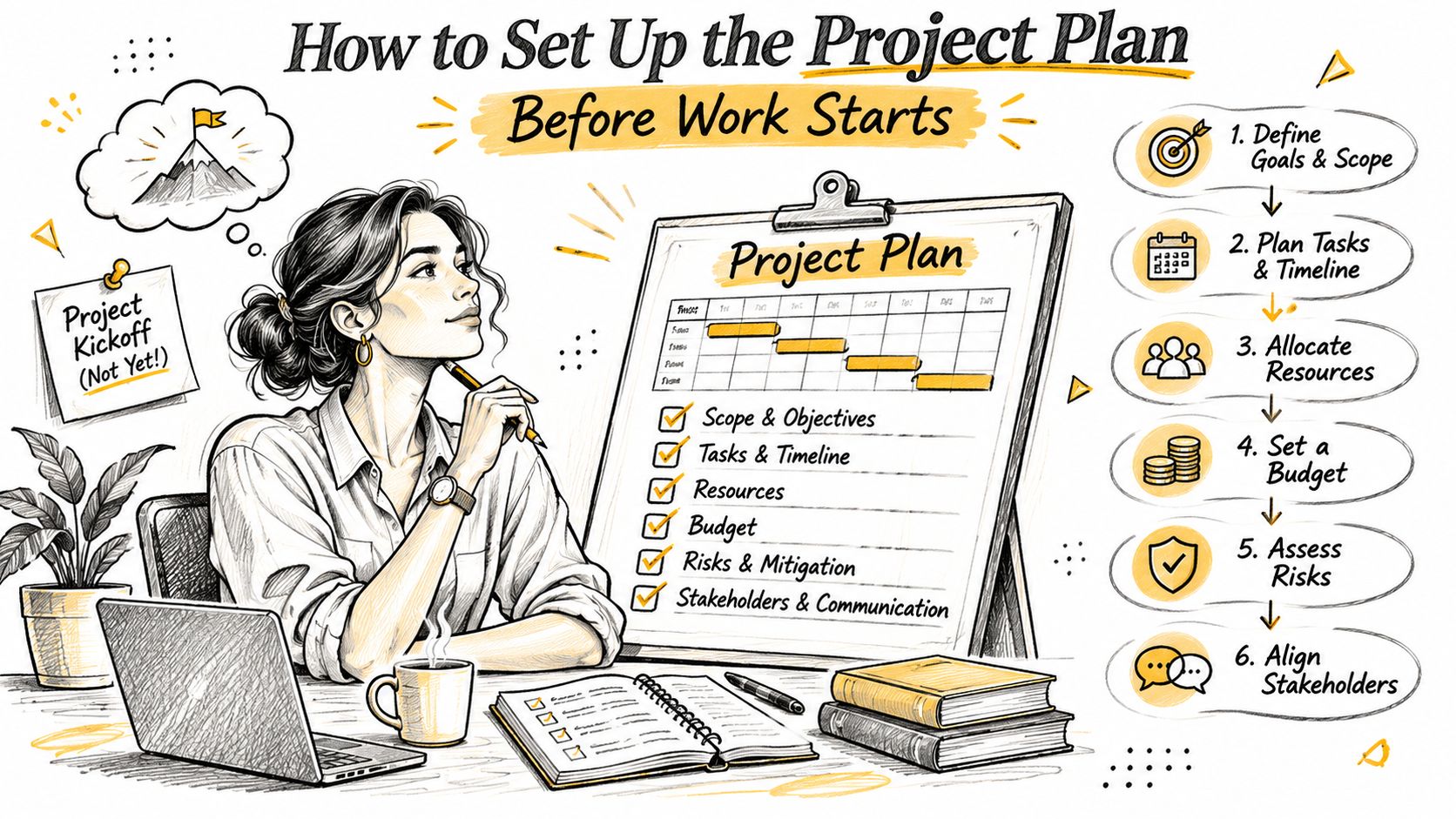
The CMAA owner guidance treats the construction management plan as a written document the construction manager prepares and usually folds into the wider project management plan. It should cover the project description, the owner's goals, scope, budget, and master and milestone schedules. Build it in this order.
- Confirm the description, goals, and scope with the owner and the design team. Do this first so later dates sit on an agreed scope. The common slip is a verbal scope that never matches the drawings.
- Set the budget baseline and split contingency by cost category. A single lump contingency hides which trade is already consuming it. Leaving the split for “later” means the first change spends money nobody assigned.
- Build the master schedule, then the milestone dates the owner can check. Put procurement lead times on the logic, not in a side note. Schedules that ignore shop-drawing and fabrication time look fine until the first long-lead item misses.
- Write who prepares, who approves, and who signs for budgets, pay applications, change orders, design revisions, schedule recovery, and final acceptance. Undefined approvals are how a coordinator accidentally commits the owner. The preconstruction side of that table is easier to staff once you know who belongs on the preconstruction team.
- Set the reporting rhythm and response times for RFIs and submittals. A weekly meeting with no due-date rule still lets items age in the log.
- Agree escalation thresholds for cost increases and schedule slips, in dollars and in days. “Tell me if it gets bad” is not a threshold.

Practical rule: If a duty has no named approver in the plan, it is not ready to hand to anyone, on site or remote.
The finished plan is what decides the remote slice. A coordinator can keep the milestone schedule, publish minutes on a set clock, update RFI and submittal logs, and issue variance reports. Approval of money, design, recovery method, and final acceptance stays with the people the plan names.
Keeping Schedule and Cost on Track
Delays rarely come from one event. A late drawing postpones a buy, the buy pushes installation, and labor and equipment stay on the clock while successor work waits. A peer-reviewed review of infrastructure projects put variations or extra work, delayed drawing preparation and approval, poor site management, and poor planning among leading delay risks, and separate research in that review found that execution is the stage where time and cost deviations mainly show up.
Four controls that stop the chain
Keep a logic-linked baseline and do not overwrite it. Updates show variance against that frozen plan. Replacing the baseline every Friday erases the story of what moved.
Name an owner for every critical and near-critical constraint. A constraint without a person is a hope. The owner might be the designer for a missing detail, procurement for a release, or the superintendent for access.
Measure planned versus actual in quantities, not in a percent someone typed into a spreadsheet. Feet of pipe, cubic yards, or rooms closed give you something a pay application can be checked against.
Use earned value on top of those quantities. Schedule variance is earned value minus planned value. Cost variance is earned value minus actual cost. Say earned value is $200,000 and actual cost is $230,000. Cost variance is minus $30,000. That is a reason to look before the next pay application, not a verdict by itself. Earned value is only as good as the cost breakdown behind it. A lump cost code will print a clean number that means nothing.
Changes and recovery
Every change gets a written scope, time impact, and cost impact before anyone authorizes the work. Schedule updates keep the original baseline so the variance stays visible.
Recover in order of cost. Resequence first. Expedite procurement second. Use targeted overtime last, and only on the activity that is driving the end date. In the record, separate contractor-caused delay from owner, designer, procurement, or force-majeure delay. Mixing those causes in one narrative makes a time extension impossible to defend. If estimating capacity is the bottleneck behind late budgets, it helps to know what a construction estimator costs to hire before you ask the project manager to price every change alone.
Managing RFIs, Submittals and Change Orders
An open question has a price tag. A Navigant Construction Forum analysis, covered in Bluebeam's RFI guide, looked at 1,083,807 RFIs across 1,362 projects and found an average of 796 RFIs per project. Each took about eight labor-hours and $1,080 to review and answer, which implies roughly 6,400 hours and $860,000 of effort on an average project in that set. Median response time was 9.7 days. Treat the log as schedule risk, not as mail.
What the register must hold
Keep six fields on every RFI: responsible party, contractual due date, drawing or specification affected, cost exposure, critical-path impact, and a link to the answer. Sort follow-up by the earliest activity the item can delay, not by which architect replied last.
Submittals need the same discipline in a lighter form: a log, a completeness check before the package leaves your office, and a tracker for the review cycle. A submittal that goes out missing a cut sheet burns the review clock twice.
Change orders need documented scope, cost, and time impact, plus authorization before the work proceeds. Verbal “go ahead, we'll paper it later” is how unpriced work lands in a dispute.
As-built and BIM files need version control so the model shows approved changes, not a foreman's markup. Pay applications follow the same pattern. Check claimed progress against field quantities before the owner approves payment.
Who prepares and who decides
A coordinator can log an RFI, route it, and chase the date. That person should not interpret the contract or the drawing alone. Coordinators who answer technical questions without a named decision owner create conflicting instructions on site.
- Prepares: the coordinator drafts the log entry, the transmittal, and the aging list.
- Decides: the designer answers a design question, the owner authorizes scope and money, and the contractor confirms means and methods inside the contract.
- Escalates: any item that can hit the critical path, or that is past its contractual due date, goes to the named owner the same day, not at the next progress meeting.
A clean log has no open item without an owner and a due date. If either field is blank, the item is not under control.
Safety, Quality and Code Compliance Duties
The common mistake is treating safety as paperwork because the project manager sits in an office. An OSHA partnership example expected the superintendent or manager to hold site-safety and health responsibility, backed by written project safety programs, task-hazard analysis, weekly toolbox talks and training records, fall-protection plan evaluation, corrective-action tracking, and injury and illness data. That example used national baselines of 3.2 for total recordable case incidence, 1.9 for days-away, restricted, or transfer cases, and 1.3 for days-away-from-work cases, drawn from 2016 BLS data. Treat those figures as dated comparison points, not as targets. Check current BLS injury data before you put any rate in an owner report.

Records versus authority
Quality follows the same line. The project manager schedules inspection hold points, tracks punch-list items, and keeps the record. Acceptance stays with the inspector or design professional who is responsible for that scope. A punch list closed in the software is not the same thing as work accepted in the field.
Code and permit tracking is a log of status and deadlines. Interpretation and sign-off belong to the licensed person named for each approval. A coordinator can remind you that a footing inspection is tomorrow. That coordinator cannot decide that the footing meets the code.
Put the boundary in the project plan in writing.
- The manager's records: inspection logs, training logs, corrective-action registers, permit status, and incident paperwork.
- On-site or licensed authority: field observation, hazard assessment, enforcement, stop-work, code interpretation, and sign-off.
Set an immediate escalation rule for any imminent hazard. Nobody waits for the next report cycle to flag a missing guardrail or an unprotected opening. Remote staff can keep the registers current. They are not a substitute for the person who can stop the work.
Reporting and Owner Communication
A report is useful only when every number traces back to a source record. Percent complete copied from last week, with no log behind it, is a story.
Use a small set and keep each piece tied to a cause.
Weekly progress carries milestone status and the look-ahead. Aging shows RFIs and submittals past their due dates. Open change orders show status, not just a count. The monthly cost report carries a forecast at completion. Pay applications appear as a short summary of what was requested, what the field records support, and what is still held.
Each of those items needs four lines: the variance, its cause, the responsible party, and the recovery action with a date. A green status next to a quiet aging list is how overdue questions hide. Put overdue RFI and submittal counts beside percent complete so the owner sees both.
Metrics worth keeping
Beyond schedule variance and cost variance, track RFI aging, submittal turnaround, change-order cycle time, forecast accuracy, and the count of unresolved field issues. Each added metric adds data entry. Keep only the set the team will maintain, and drop any metric nobody acts on. A dashboard that nobody opens is overhead.
The project management documents behind the report, the logs, the baseline, and the approved changes, are what make the numbers defensible. Send the report to the owner only after its author has reconciled it to those source logs. If the log and the slide disagree, fix the slide before the meeting.
Decide Which Duties to Delegate First
Firms rarely hand off a whole role. They hand off a set of duties. For each one, ask three questions. Is the work recording or deciding? Does it need someone physically on site? Does it require a license or contractual authority?
| Duty | Remote support can own | Keep with on-site or licensed lead | Check before delegating |
|---|---|---|---|
| Schedule maintenance | Look-ahead updates, milestone tracking, status collection | Critical-path decisions and recovery method | Software access and an agreed update cadence |
| RFI and submittal logs | Logging, routing, follow-up and aging reports | Technical answers and contract interpretation | A named decision owner for every item |
| Change-order administration | Documenting scope, cost and time impact | Authorization and scope approval | Written approval limits |
| Owner reporting | Drafting weekly and monthly reports | Variance explanation and forecast sign-off | Reports reconciled to source logs |
| Safety and inspections | Record keeping, training logs, corrective-action register | Field observation, hazard assessment, enforcement | A written boundary and an escalation rule |
| Code and permit tracking | Permit and inspection status logs | Code interpretation and sign-off | A licensed professional named for each approval |
Start with logs and reporting, where a wrong entry is visible and reversible. Move to schedule maintenance and change-order paperwork only after approval limits are written down. Touch safety-related tasks only after the field boundary is in the plan, and leave code interpretation with the licensed professional.
Remote coordinators take administrative load off senior staff. When decision owners are unclear, they add coordination overhead, because two people answer the same question differently. The same trap shows up outside construction, which is why scaling output with Fluidwave is worth a look before you add a seat. Name the owner first.
Our project managers work inside Procore, Buildertrend, and Monday, overlap client working hours, and can join client calls. The practical test we use is a schedule or RFI exercise, so you see how someone handles a log before they touch a live job. On a 20-minute call you tell us the role, the software, and the hours. Most clients give the hire a seat in their own platform so the files never leave their system. Confirm that access before the first assignment.
This week, list the duties you perform, tag each with the three questions, and write the answers into the project management plan.
The Takeaway
A construction project manager owns the whole project: planning, scheduling, coordination, documentation, cost control, reporting, and safety oversight. Those duties overlap, so a late drawing is never only a drawing problem.
Before you hire for them or hand any of them off, write down who decides, who records, and who signs, using the construction management plan as the reference. Set roles, approval limits, and escalation thresholds first, then keep the schedule, RFI, and change-order logs current, because that is where cost and delay show up. Keep field safety, code interpretation, and acceptance with the people who hold authority over the site and the permit.
Delegate recording and follow-up first, where a mistake is visible and reversible, and widen the scope only after decision owners are named in writing. After the first month, run each delegated duty back through the three questions and pull back anything that creates more coordination than it removes. If you are assembling remote support, use the delegation table as the starting scope for the job description, and confirm contract, licensing, and insurance questions with qualified counsel before you assign responsibility.
HireArchitects places remote construction project managers who keep schedules, RFI and submittal logs, change orders, and owner reports moving while your licensed leads keep the decisions. If you want that split written into a real scope, visit HireArchitects and tell us the duties you are ready to hand off.