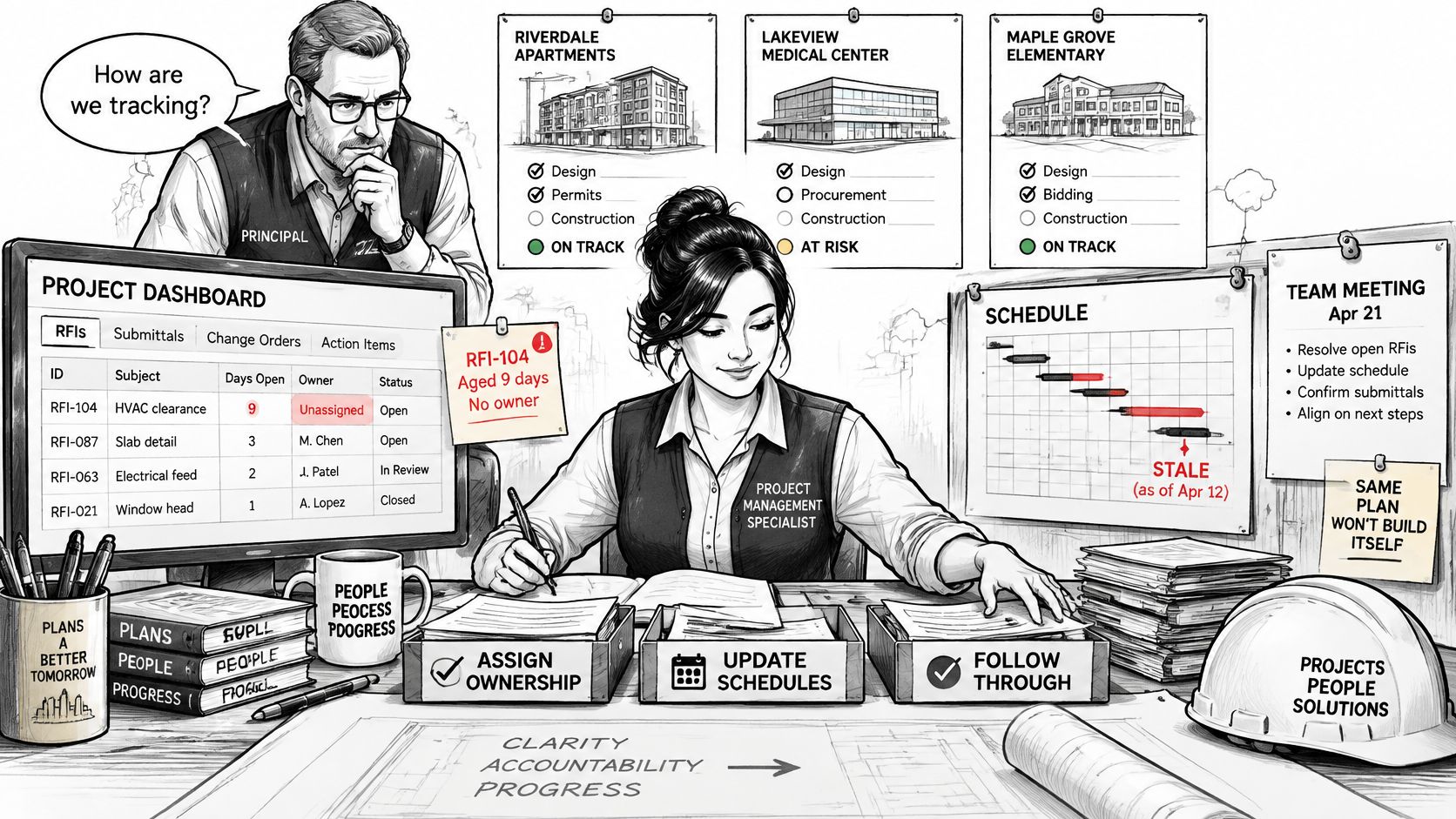
A principal is managing three active jobs. One request for information has been waiting nine days without an assigned owner, and the schedule hasn't been updated since the last meeting. The problem isn't necessarily that the design team lacks skill. It's that nobody is consistently maintaining the records, tracking deadlines, and making sure the right person knows what needs a decision.
That's the practical purpose of a project management specialist: to keep coordination work visible and moving without taking technical or professional decisions away from the people qualified to make them. In a design or construction firm, that means maintaining schedules, document logs, change records, cost reports, and follow-up. In a medical practice, similar skills can help organize non-clinical projects, but privacy and clinical boundaries must be explicit.
This guide explains what the role should own, how to test a candidate's judgment, which project controls are useful, and how to measure whether a specialist is adding team capacity. The central question isn't just what the person's job title says. It's whether each open loop has an owner, a next action, and a clear decision-maker.
What a Project Management Specialist Owns on a Project
When an RFI sits without an owner and the schedule goes stale, the specialist's job is to restore visibility. They maintain the coordination records and prompt the appropriate people to act. They don't decide what the design should be, approve a budget change, or direct field work unless those responsibilities are explicitly assigned and appropriate to their qualifications.
In the United States, project management specialists are a formally recognized business-and-financial occupation. The U.S. Bureau of Labor Statistics occupational profile says the occupation coordinates scope, schedules, budgets, staffing, procurement, documentation, and stakeholder communication. It reports a median annual wage of $102,320 in May 2025 and projects 7% employment growth from 2025 to 2035, faster than the average for all occupations. Those figures reflect a professional control function, not mere clerical support.
Responsibility follows the work, authority stays with the decision-maker
The useful distinction is between coordinating a decision and making it. A specialist can identify a schedule impact, assemble the relevant records, and route the issue to the principal. The principal or licensed professional retains the decision that requires their authority.
| Function | Typical tasks | Output the team sees | Decision stays with |
|---|---|---|---|
| Schedule control | Maintain master and look-ahead schedules; track activity status | Updated schedule and slip log | Project lead approves milestone changes |
| Document control | Track RFIs, submittals, and revisions through to closure | RFI and submittal logs with aging | Architect or engineer answers technical questions |
| Change management | Log change requests and link them to budget and schedule | Change log with approval status | Principal approves cost and scope changes |
| Cost tracking | Compare committed, billed, and forecast cost | Monthly cost report | Owner or principal approves budget changes |
| Stakeholder reporting | Prepare agendas, minutes, and owner status reports | Status report and action list | Principal presents to the owner |
| Subcontractor coordination | Follow up on buyout, submittals, and delivery dates | Coordination record | Field supervisor manages site work |
| Team coordination | Run coordination meetings and assign action items | Issue tracker with owners and due dates | Design lead sets design direction |
A good specialist can show what is waiting, who owns it, how long it has been open, and what happens next. A weak setup generates meeting notes without named owners or status reports that repeat problems but don't route them to someone with authority. For more on how responsibilities fit together before construction, see this guide to preconstruction team roles and responsibilities.
The occupation spans construction, architecture and engineering, information technology, healthcare, finance, manufacturing, and government. The examples here focus on design and construction firms; the same ownership principle can apply to non-clinical medical-practice projects, where patient privacy and clinical authority require additional safeguards.
Core Skills and How to Test for Them
A strong project management specialist combines scheduling, cost and change awareness, document discipline, and clear communication. Software fluency matters, but it's not a substitute for knowing what needs attention or when an issue must be escalated.
During a normal working week, scheduling competence looks like turning the master schedule into a useful look-ahead, checking dependencies, and flagging activities that need a decision or response. Cost and change literacy means linking a proposed change to affected activities and budget lines, then explaining the consequence to a principal in plain language. Document discipline means reconciling an RFI log against the drawing register so the team can see which revision an open question concerns.
Information coordination is a control skill
BIM literacy is more than knowing how to open a model. The National Institute of Standards and Technology's BIM publication describes BIM as a digital representation of the building process intended to support information exchange and interoperability. For the specialist, that means managing naming conventions, revision status, model exchanges, issue ownership, and links between coordination findings and schedule or procurement work.
For example, if a coordination meeting identifies a clash, the issue should name the responsible discipline, affected location, drawing or model revision, due date, and closure status. Without those details, people may review different versions, duplicate work, or carry an unresolved issue into downstream documentation. A model issue list is useful only when it creates accountable follow-up.
Test the work, not the résumé
Give candidates a practical exercise: ask them to build a short schedule from a scope list, or sort a batch of RFIs by urgency and missing information. The goal isn't to test whether they can make a polished chart. It's to see whether they identify dependencies, spot unclear inputs, assign owners, and explain what requires a principal's decision.

Strong software fluency with weak escalation judgment produces more reports, not more control.
A candidate who can organize information but fails to flag a missing approval may leave a project exposed. A candidate who escalates every routine follow-up, on the other hand, can add unnecessary interruptions. Ask the candidate to explain why each item is urgent, what they would do next, and who has the authority to close it.
Running Project Controls from Scope to Closeout
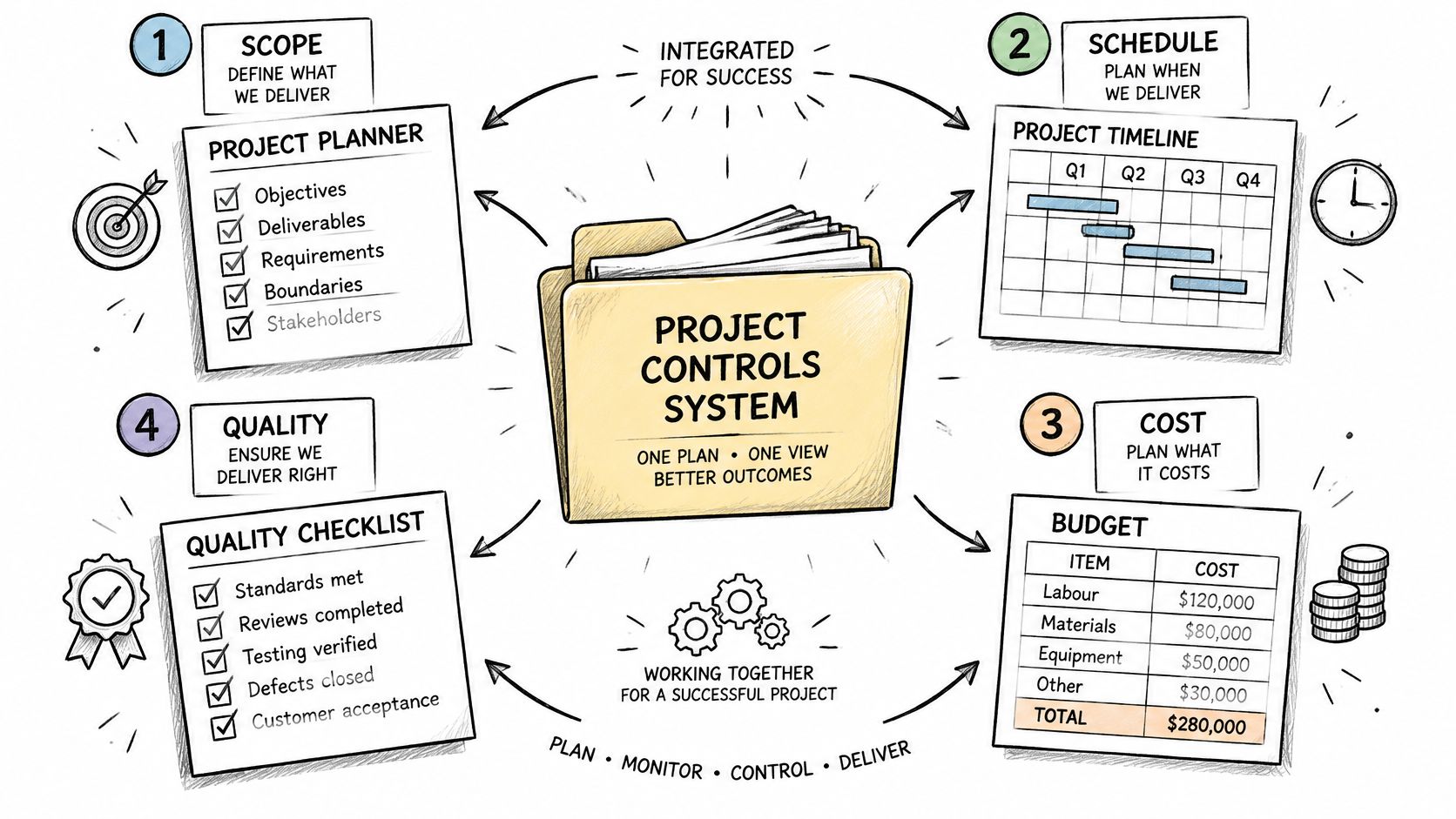
Scheduling, scope, cost, and quality work best as one control system. If each is tracked separately, the team can miss how a design revision affects both the forecast and the completion date. The Construction Management Association of America identifies written scope, a detailed scope-based budget, milestone cost estimates, a master schedule, and milestone schedules as foundational controls in its project-delivery guidance.
Set a usable baseline before tracking changes
Write the scope. Describe the work in terms the owner and design team can both confirm. This gives the team a reference for what is included and what requires approval.
Build a scope-based budget. Connect costs to the defined work and include milestone estimates. The specialist can maintain the record, while the owner or principal approves the budget.
Create the schedules. Establish a master schedule and milestone schedules tied to decisions, reviews, and deliverables. Dates without dependencies can look precise while hiding a blocker.
Cost-load where it helps. Associate planned value with schedule activities so the team can compare planned, earned, and actual performance. This can support forecasting, but only if the job is complex enough to justify maintaining the added detail.
Open a change log. Link each change to affected activities and budget lines, responsible parties, approval status, and forecast completion date. A change described only in meeting minutes is hard to evaluate later.
Set data rules. Agree on activity codes, responsibility assignments, status dates, and documented assumptions. Use the same conventions across the project so reports can be compared without constant interpretation.
Once those baselines exist, the team can evaluate a later RFI, design revision, procurement delay, or change order against a known time-and-cost reference. The specialist can show what changed and who needs to respond, instead of relying on informal updates that may leave the owner unclear about the impact. For design professionals, project management practices for architecture and design teams can help frame the control work around the project's actual delivery process.
A small remodel may not justify a cost-loaded schedule. On a short, straightforward job, the time spent maintaining a detailed cost model can exceed its value. Keep the controls proportionate: use enough structure to identify changes and responsibilities, but don't impose a reporting system the team can't maintain.
Tools the Role Uses and Who Provides Them
Software should support a shared process, not substitute for one. The table below maps common tool categories to the records they carry and the people who typically own them.
| Category | Example platforms | Work it carries | Typical owner |
|---|---|---|---|
| Project management platforms | Procore, Buildertrend | RFIs, submittals, daily logs, owner reports | Project manager, with client admin rights |
| Scheduling | Primavera P6, MS Project | Baseline, look-ahead, critical path, progress updates | Scheduler or project manager |
| Markup and takeoff | Bluebeam Revu, PlanSwift, STACK | Drawing markups, quantities, bid packages | Estimator or project team |
| Drawings and BIM coordination | AutoCAD, Revit, Navisworks, SketchUp | Drawings, models, clash reports | Design team and BIM coordinator |
| Shared records | Excel, shared drive, or client document system | Registers, logs, meeting minutes | Specialist maintains, client owns files |
Agree on software access before the start date. Many firms provide a seat in the client's system so project files stay within their environment; some professionals may also have their own licences. Confirm who provisions access, administers permissions, and owns the project records. HireArchitects' project managers work in Procore, Buildertrend, and Monday, overlap client working hours, and can join client calls.
One project record should have one agreed home.
If the same RFI is maintained in a platform and a separate spreadsheet, the two records can drift apart. A small firm may be able to use a well-maintained spreadsheet and shared folder, provided everyone updates the same register. Before selecting or changing a platform, check the vendor's current documentation, because features can change between versions.
Where AI Fits and Where Accountability Stays Human
AI-use surveys don't describe a single uniform level of adoption. In a 2025 Association for Project Management survey of 1,000 project professionals, seven in ten said AI was integrated into everyday processes, and the same share said it improved project outcomes. A separate APM study focused on construction project delivery found that 28% of construction project professionals considered AI fully embedded in their workflows; that research also found 29.6% of project managers identified accuracy and trust as the biggest barrier to using more AI.
The studies describe different populations and may reflect different definitions of “integrated” and “fully embedded.” Treat them as directional, not as a reason to automate decisions before defining who reviews them.
Approve specific uses and name the reviewer
Reasonable administrative uses may include drafting meeting summaries, classifying RFIs, flagging possible schedule risks, and organizing change-order logs. For each use, set a human review step before the output goes to an owner or into the contract file. Keep an audit trail, define confidentiality rules for drawings and client information, and require escalation when output could affect cost, schedule commitments, or code compliance.
Licensed architects and engineers retain code and design sign-off. A project management specialist shouldn't present AI output as a professional determination. The same rule applies in a medical practice: if an AI tool would touch patient information, confirm with qualified counsel or a compliance professional whether a business associate agreement is required. Don't put protected health information into a tool that lacks the necessary contractual and security arrangements.
Applying the Role in a Medical Practice
A project management specialist can coordinate non-clinical work inside a medical practice: a second-site buildout, an EHR upgrade, a payer or credentialing changeover, or a new scheduling and intake workflow. The role is to maintain the plan, collect dependencies, track decisions, coordinate vendors, and raise delays early. It doesn't include making clinical decisions or setting clinical protocols.
Consider a three-provider primary care group opening a satellite office. A specialist could track permit milestones, equipment delivery, staff training dates, and vendor scope additions in a change log. The practice manager would retain authority over the opening date. If the project includes an imaging room, required approvals and inspections should appear on the milestone schedule; a standard exam-room buildout may need fewer such milestones.
Protect patient information and clinical authority
Medical practices have a measurable administrative workload. The American Medical Association's report on physician work and EHR use says physicians averaged a 57.8-hour workweek in 2024, including 27.2 hours of direct patient care and 13 hours of indirect patient care. That supports assigning non-clinical coordination work deliberately, rather than leaving providers to act as the default project office.
A remote specialist who can access scheduling, billing, referrals, or patient records may handle protected health information. The Department of Health and Human Services' business associate guidance explains that a business associate arrangement generally requires satisfactory assurances through a business associate agreement, with permitted uses and disclosures and applicable Privacy Rule obligations. Confirm the practice's obligations with qualified counsel or compliance professionals before granting access. Use minimum necessary access and approved systems, and keep project records limited to what the coordination work requires.
A single-site practice with stable workflows may not need a dedicated specialist. The role is most useful when several departments, vendors, deadlines, or approvals must be coordinated, and the practice has made clear which decisions remain with its providers and managers.
Measuring the Specialist's Contribution to Team Capacity
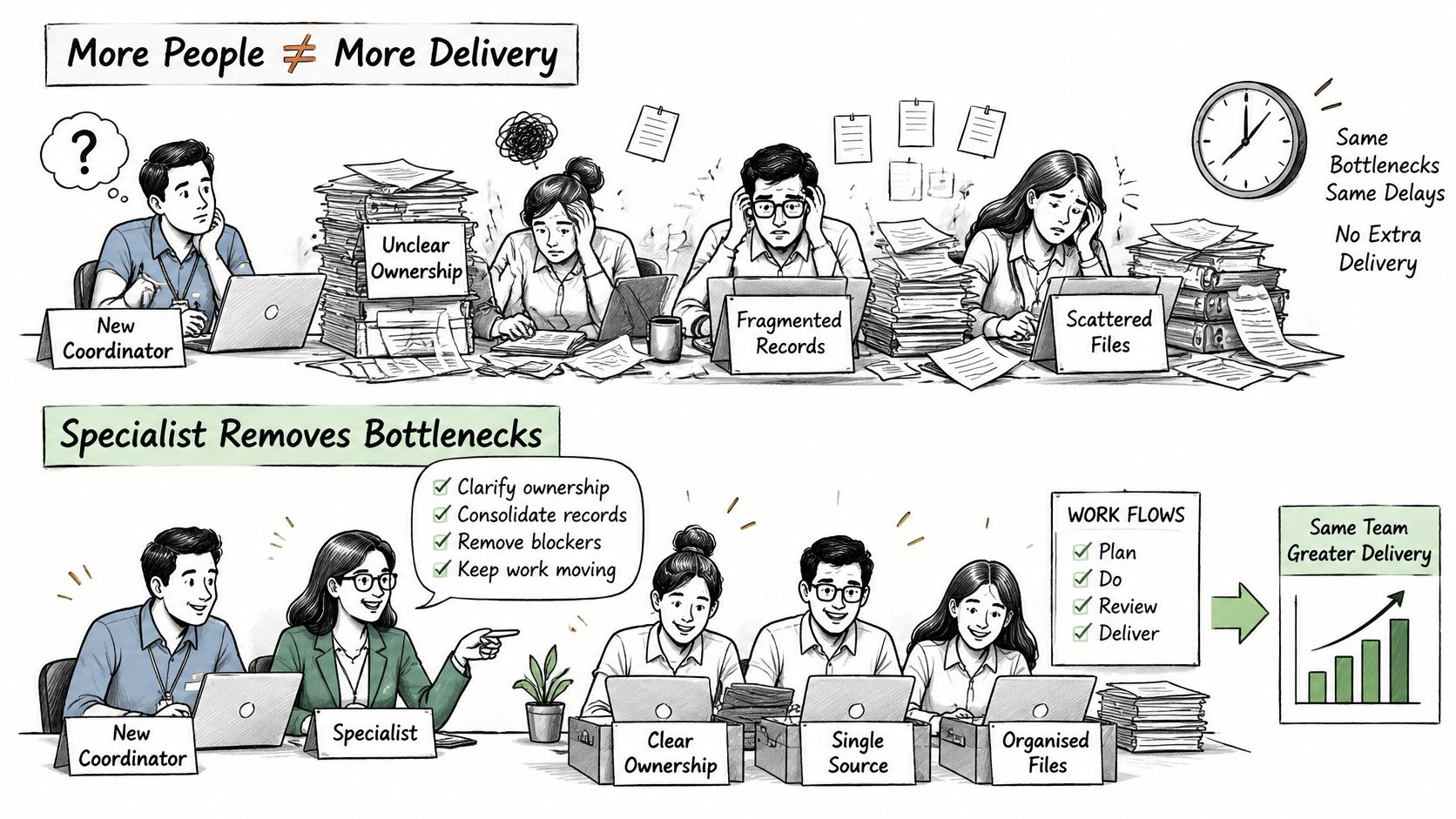
Adding a coordinator doesn't automatically add delivery capacity. If nobody agrees who owns the schedule, where the official record lives, or who approves a change, the new hire may spend their time reconstructing fragmented information instead of closing open items.
The Bureau of Labor Statistics' project management and construction employment information describes projected employment growth for these occupations, alongside construction productivity measures. More staff can support delivery, but headcount alone doesn't resolve unclear ownership, incomplete records, or rework.
Establish ownership in the first month
Use the opening weeks to create reliable records, not to flood the team with new reports:
- Week one: Map open RFIs and submittals, including their owners, status, and age.
- Week two: Confirm the schedule baseline and update status dates with the responsible leads.
- Week three: Agree on a change-log format that links changes to budget lines and schedule activities.
- Week four: Run the first weekly coordination meeting with named owners and a documented action list.
Track a small set of operating measures: schedule-update timeliness, RFI and submittal aging, change-order completeness, forecast variance, and the share of decisions recorded with a date and owner. A 2025 State of Project Management finding reported by Proteus says 38% of organizations mostly or always completed projects on time. That finding gives teams a reason to measure schedule reliability, but it doesn't establish that hiring a specialist alone will improve it.
Separate coordination performance from external causes. The specialist can be accountable for keeping a log current, assigning follow-up, and escalating a missing decision. The principal, superintendent, architect, or engineer retains decisions in their remit. Design changes, procurement delays, and field conditions may affect dates even when coordination records are excellent. Remote professionals usually keep full U.S. business hours so they can join meetings, bid reviews, and site calls live.
Hiring Criteria and a Screening Scorecard
A résumé can show software names and job titles without showing whether a candidate can maintain a usable control record. Score the evidence from an exercise, not the volume of credentials. For each criterion, record what the candidate did, what they missed, and why the score reflects the work.
| Criterion | Strong evidence | Weak signal | Practical test |
|---|---|---|---|
| Schedule control | Built and maintained a schedule through a change | Describes scheduling only as a software feature | Build a short schedule from a scope list |
| Document control | Kept RFI and submittal logs with aging and closure dates | Can't name a closure rule | Sort RFIs by urgency and missing information |
| Cost and change | Linked change orders to budget lines | Treats change orders as paperwork | Explain a change order's cost impact in two sentences |
| BIM and software | Uses your team's platforms with revision discipline | Lists software names without examples | Review a model issue list and assign owners |
| U.S. construction practice | Works with IBC and IRC requirements and imperial units | Has experience only with unfamiliar codes or metric units | Describe how specifications are organized by CSI division |
| Escalation judgment | Separates items they can close from decisions needing the principal | Escalates everything or nothing | Present a design conflict and ask what gets escalated |
| English communication | Writes clear minutes and action items | Provides vague status notes | Review sample meeting minutes |
Make the exercise resemble the work
A practical hiring process can combine an English check, a portfolio or experience review, and a role-specific exercise. For project managers, use a schedule or RFI exercise. Ask the candidate to explain the assumptions they made and identify missing information before they commit to dates or owners. HireArchitects interviews candidates, checks English, and gives each candidate a practical test suited to the role.
For U.S. construction work, ask how the candidate handles imperial units, CSI divisions, and IBC or IRC requirements. Familiarity with those conventions helps with specifications and schedules, but it doesn't authorize code interpretation or professional sign-off. Remote professionals supporting U.S. projects can bring experience with these methods; verify the fit against the work your team needs.
A candidate with strong platform experience but no evidence of closing issues may need coaching in follow-through. Someone who understands controls but communicates poorly in writing may struggle with remote handoffs. Score both the work and the communication needed to keep the team aligned.
Deciding Whether Your Team Needs a Specialist Now
A specialist may help when several active projects draw on the same principals for routine coordination, RFIs and submittals age without owners, schedules are updated only before owner meetings, or change orders are priced after the fact. The role won't fix a project where the team hasn't agreed on scope, budget baseline, or who approves changes. Set those decision rights first.
Prepare in this order:
- Write a one-page role scope using the responsibility matrix in this article.
- Choose the platform and register that will hold the official project records.
- If the work involves protected health information, confirm access rules and whether a business associate agreement is needed before onboarding.
- Prepare the schedule or RFI exercise before interviews.
Without that groundwork, a new specialist may spend the first month reconstructing records. Remote staffing is one option when the work can be managed through clear systems and live coordination. A brief project management advisor scoping discussion can help define the role, software, and working hours before you review candidates.
The Takeaway
A project management specialist should own the coordination system: schedules, logs, change records, follow-up, and reporting. Technical, clinical, financial, and field decisions stay with the people authorized to make them. Test candidates on practical work, define the official record, and measure whether open items are moving.
For medical practices, apply the same ownership logic to non-clinical projects while limiting access to patient information and keeping clinical authority with providers. The role pays back when it closes open loops, not when it adds reports.
HireArchitects connects U.S. firms with remote project management professionals from Latin America who support schedules, RFIs, submittals, change orders, and owner reporting. If you're defining a role or comparing candidates, visit HireArchitects to discuss the software, hours, and project controls your team needs.