Your drawing backlog is growing, another bid invitation has arrived, and the senior person who should be reviewing work is still cleaning up sheets. A remote staffing agency can help you recruit and place professionals who handle production tasks inside your team's systems. But adding someone remotely won't solve a workflow that leaves inputs, decisions, and review authority unclear.
The useful question isn't whether a remote drafter or estimator costs less. It's whether that person can deliver an output your reviewer can accept without rebuilding it. A completed takeoff that omits scope, or a Revit model that loses information during exchange, can consume the senior capacity you meant to free up.
For U.S. architecture, engineering, and construction firms, remote staffing works best as an operating-control decision. Define the work that can move, retain the right approval authority, and measure accepted output rather than activity. The agency can support recruiting and administration, but your firm still needs to own technical direction and project decisions.
Before comparing candidates, establish the hiring model, the deliverables, and the true cost of supervision. Those choices determine whether you're buying useful production capacity or creating another coordination burden.
How a Remote Staffing Agency Differs From Other Hiring Models
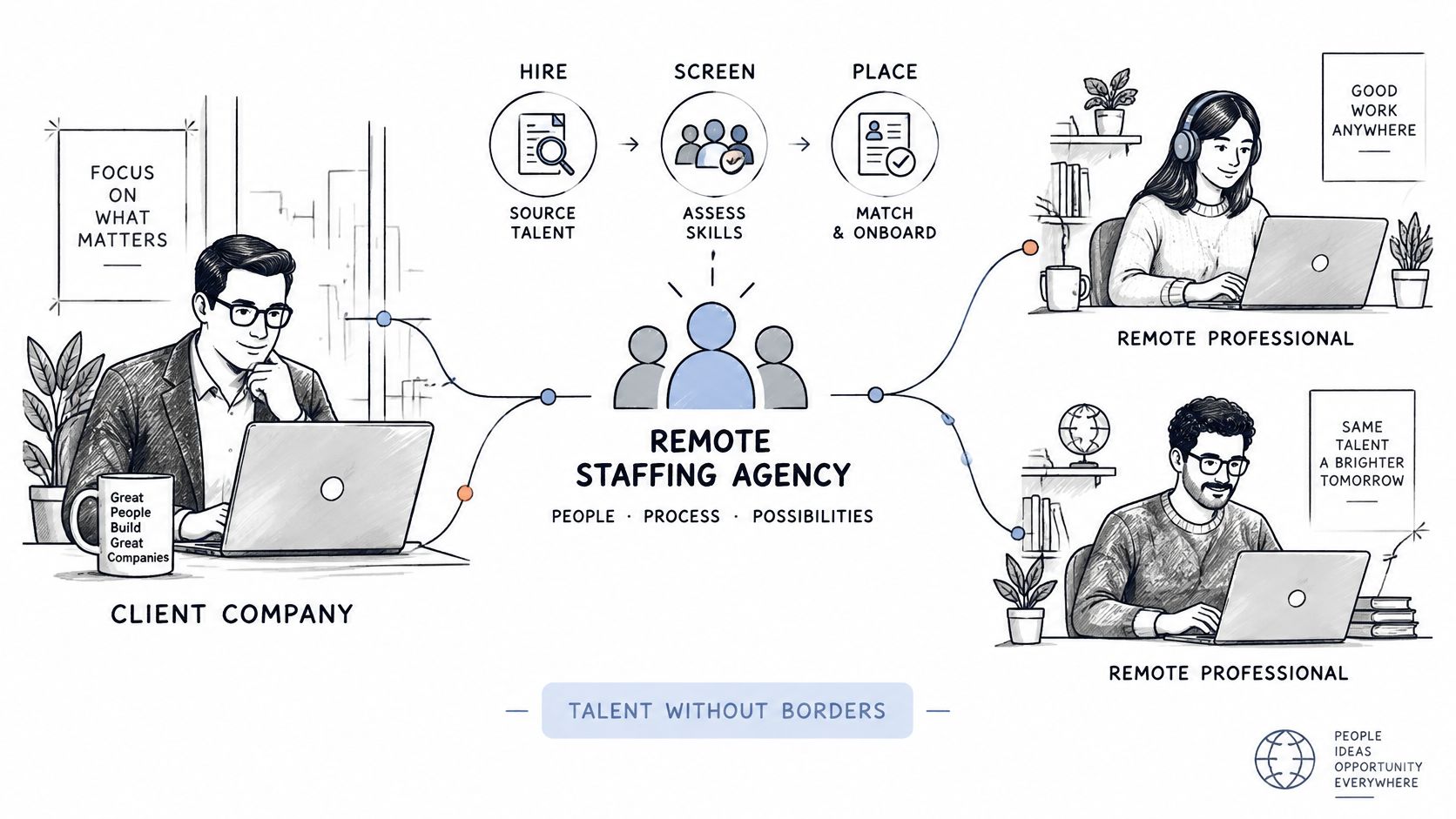
Say your firm needs drafting capacity to clear a construction-document backlog, but you don't know whether the workload will support another permanent position. A remote staffing agency recruits, vets, and places professionals who work on your team's assignments. In some arrangements, the agency or its contracting partner also handles employment, payroll, and administrative compliance.
Don't assume every agency is the employer. Recruiting, contracting, payment administration, and legal employment are different functions, even when one provider coordinates them.
Hiring Models Compared for Architecture and Construction Firms
| Model | Who employs the worker | Who handles payroll and compliance | Typical cost structure | Best fit |
|---|---|---|---|---|
| Direct US hire | Your firm | Your firm | Salary, benefits and recruiting fees | Core roles needing constant on-site presence and direct management |
| Remote staffing agency | Agency or its contracting partner under an employment-based arrangement | Agency under the agreed service scope | Typically monthly or per-placement fees | Production roles needing steady, adjustable capacity under your daily direction |
| Freelance marketplace | Independent contractor, not an employee under a genuine contractor arrangement | Contractor handles business obligations; client handles applicable reporting | Per project or hourly | Short, self-contained tasks managed against deliverables |
| Employer of record | Employer of record company | Employer of record company | Service fee on top of salary | Hiring abroad without a foreign entity while retaining daily task direction |
| Offshore subsidiary | Your own foreign entity | Your firm through its foreign entity | Setup and operating costs | Large teams on a long horizon with direct operational control |
A direct hire gives you control and an opportunity to build institutional knowledge, but you carry recruiting, compensation, benefits, and onboarding responsibilities. Freelancers can suit a bounded assignment, while continuity and availability require closer attention. An employer of record addresses overseas employment administration, not technical supervision; a subsidiary adds control alongside a substantial setup burden.
The Bureau of Labor Statistics projects approximately 174,800 openings per year across architecture and engineering occupations from 2025 through 2035, reflecting growth and replacement needs. That broad demand supports considering flexible capacity, but it doesn't establish which hiring model fits your workload.
Separate the Service From the Employment Relationship
HireArchitects helps U.S. architects, contractors, and design-build firms hire vetted professionals from Latin America. We connect clients with architectural professionals worldwide and don't act as an employer or guarantee employment, so the written agreement must identify the actual contracting and employment relationships.
Use this comparison of in-house, freelance, and remote drafting hires to assess continuity and control alongside price. Before signing, establish who employs the professional, who pays them, and who handles a poor fit. Worker classification is jurisdiction-specific, so have qualified counsel confirm the arrangement rather than relying on the agency label.
Roles and Deliverables Remote Teams Cover in Design and Construction
Buy an output, not a broad job title. A candidate described as a project manager might be strong at document control but unprepared to own schedule logic; a Revit technician might produce clean sheets without being ready for multidisciplinary coordination.
Estimating and Preconstruction
Estimators and quantity takeoff specialists prepare measurements, subcontractor comparisons, bid packages, budgets, and unit-rate databases using tools such as Bluebeam Revu, PlanSwift, and STACK. The assignment should identify drawing revisions, measurement rules, exclusions, and how assumptions must be recorded.
For a specialty contractor, the useful deliverable might be a traceable takeoff organized by area and scope, not a single total. Confirm the output and software, then name the estimator or preconstruction lead who approves scope and pricing. This guide to preconstruction roles and responsibilities helps distinguish estimating production from broader preconstruction coordination.
Drafting and Architectural Documentation
Draftspersons, architectural and structural drafters, CAD specialists, and Revit technicians can prepare permit-set components, construction documents, shop drawings, as-built drawings, and revisions. Specify the required source material: approved markups, surveyed information, consultant backgrounds, or field-verified records.
Our architects work in Revit, AutoCAD, SketchUp, and Rhino, understand IBC and IRC requirements, and follow client title block, layer, and sheet standards. Confirm whether you need a markup implemented or an unresolved detail developed, and assign the appropriate architect or engineer to review the result.
BIM and Design Support
BIM modelers and coordinators build models, manage coordination information, and prepare exchanges. Architects, architectural designers, and MEP designers can contribute concept development, planning submissions, and construction documentation under the project's review structure.
Automation makes checking ability more valuable, not less. In Autodesk's 2025 industry findings, 68% of AECO leaders believed AI would enhance their industry, down from 80% the previous year. Test whether candidates can explain and validate AI-assisted output, including what they won't upload to unapproved tools, rather than merely demonstrate commands.
Project Administration and Coordination
Remote project managers can maintain schedules, RFIs, submittals, change orders, subcontractor follow-up, and owner reports. Across these roles, our professionals work in AutoCAD, Revit, Bluebeam Revu, PlanSwift, STACK, Procore, SketchUp, and MS Project.
For each assignment, confirm which output, in which system, reviewed by whom. Updating an RFI log is a defined administrative responsibility; deciding the technical answer is a different assignment.
Which Tasks Suit Remote Staffing and Which Stay With Your Licensed Team
A task is a strong remote-production candidate when its inputs can be transferred digitally and its output can be checked against a defined standard. If acceptance requires unresolved site knowledge or professional judgment, separate that decision from the production assignment before delegating it.
Construction's limited teleworking illustrates the boundary. The Home Builders Institute's construction labor-market report states that 9.8% of U.S. construction workers teleworked in April 2025, compared with 21.6% of the overall employed workforce. Remote staffing fits selected workflows, not the wholesale relocation of construction operations.
Delegation Matrix for Remote Architecture and Construction Tasks
The retained-responsibility column includes decisions owned by licensed professionals where required, and by authorized U.S. estimating, project-management, or field staff for nonregulated work.
| Task | Remote suitability | Remains with US licensed staff | Review checkpoint |
|---|---|---|---|
| Quantity takeoffs | High | Bid scope decisions and pricing approval through the authorized U.S. lead | Sample-check quantities against plans before bid issue |
| Drafting revisions to client standards | High | Design intent and code compliance sign-off | Title block, layer and sheet audit before issue |
| BIM model production | High | Model standards ownership and coordination decisions | Model check against the BIM execution plan before each issue |
| Submittal and RFI logs | High | Responses that require design judgment | Weekly log reconciliation with the field team |
| Schedule administration | Medium to high | Baseline schedule and delay decisions through the authorized project lead | Weekly review by the project manager of record |
| Permit set assembly | Medium | Sealing and code responsibility | Licensed professional review before submission |
| Field observation and site coordination | Low | Site decisions and safety through qualified local personnel | Handled entirely by local staff |
| Design decisions and sealing | Not delegable to remote production | Licensed architect or engineer of record | Not applicable to a production-only assignment |
Keep Preparation Separate From Approval
An overseas professional may prepare documents using U.S. conventions, but familiarity with those conventions doesn't authorize approval or sealing. The client's appropriately licensed architect or engineer must retain responsibility for regulated design and sign-off, with delegation and supervision structured to meet applicable state requirements.
Location alone isn't the legal test. A properly licensed professional working remotely is different from an overseas production hire without the relevant authorization. Confirm licensing, responsible-control, and delegation requirements with qualified counsel.

Practical rule: Delegate the production step you can describe and inspect. Keep unresolved design, field, and approval decisions with the person authorized to make them.
Say a drafter receives a markup relocating a partition. Implementing the markup may be straightforward, but an apparent conflict with an accessible route should trigger a question, not an improvised correction. The instruction package should make that stopping point explicit.
Likewise, an as-built drawing is only as reliable as its field inputs. A remote drafter can incorporate verified records, but can't establish concealed conditions from an incomplete photograph. Assign local staff to verify conditions before the documentation proceeds.
Scoping the Role and Pricing It Against Your Real Costs
Start with the request, not the advertised monthly rate. A low-cost hire with an undefined assignment can leave your principal reviewing every sheet twice, while a narrowly scoped role may release useful capacity without adding another management layer.
Write the Assignment Before Requesting Candidates
- Define the deliverables. Write a paragraph stating what the professional produces, the source inputs, output format, and software. For drafting, identify whether delivery includes native files, plotted PDFs, revision records, or all of them.
- Name the reviewer. Identify the U.S. licensed reviewer for regulated output and the authorized operational lead for estimating or administration. Reserve review time before assigning production.
- Specify availability. List working hours and the overlap required for questions and decisions. Distinguish meeting attendance from uninterrupted production time.
- Allocate software. Record which licences and accounts your firm provides and which the candidate brings. Confirm compatibility and permitted use before the start.
- Set acceptance measures. For the first 30 days, use first-pass acceptance, turnaround time, and blocked hours as an initial management plan. Establish your baseline and targets from comparable work rather than choosing an arbitrary productivity promise.
A role is ready to recruit when the candidate can understand what to deliver and the reviewer can explain what would make it unacceptable.
Understand the Hiring Sequence
Our process starts with a 20-minute scope call covering the role, software, and hours. We state that a shortlist of three vetted candidates typically arrives within 24 hours, followed by direct interviews, an optional paid test, selection, contracting, and onboarding.
Most clients reach a working start within 24 to 72 hours, according to our stated process. Treat those as provider timelines to confirm for your assignment, not a reason to skip testing or assume a specialist will be immediately available.
Published Starting Monthly Rates by Role
These are published starting rates for full-time remote professionals. Confirm current pricing and the precise scope before budgeting.
| Role | Published starting monthly rate |
|---|---|
| Draftsperson | $1,999 |
| Estimator | $2,299 |
| BIM modeler | $2,399 |
| Architect | $2,799 |
| Project manager | $2,999 |
| Senior hires | Approximately $3,500 |
Clients pay one monthly rate per full-time professional, with no placement fee, payroll, benefits, or recruiter fee on the client's side. Estimators are commonly hired part-time or full-time on monthly terms, and there's no long-term contract.
Test the Savings Against Accepted Work
Our advertised savings of up to 70% compared with a U.S. hire are a provider claim to test against your own fully loaded costs. Compare equivalent responsibility and experience, then include recruiting time, software, onboarding, management, technical review, and rework. Use the construction-estimator hiring cost guide to frame that comparison around the actual role.
Keep a simple cost worksheet that separates the monthly invoice from internal effort. Record the reviewer's time spent answering questions, correcting output, and approving deliverables; otherwise you can mistake a smaller invoice for a less expensive process.
Savings are easiest to undermine through avoidable operating gaps:
- Unclear acceptance criteria. The candidate completes work that doesn't match the reviewer's expectations.
- Delayed access. A paid professional waits for licences, folders, or permissions.
- Missing baselines. Nobody knows whether turnaround has improved.
- Premature expansion. More hires enter the same unresolved workflow.
- Weak replacement terms. A poor fit continues because the exit process is unclear.
Prove a bounded role before adding volume. The meaningful comparison is total cost per accepted deliverable, not domestic salary against a remote monthly rate.
Assessing Candidates and Providers Before You Sign
A paid exercise using your drawings and standards is a stronger signal than an attractive portfolio alone. Give an estimator a sample takeoff, a drafter a markup, or a BIM candidate a model-check assignment, then inspect both the result and the reasoning.
A useful test includes an ambiguity the candidate should flag. You're assessing whether they recognize missing information and escalate it appropriately, not whether they can guess what your reviewer intended.
Test BIM Information Exchange, Not Just Revit Commands
NIST defines interoperability as managing and communicating electronic product and project data across collaborating firms and systems, and estimated the historical annual cost of inadequate interoperability to the U.S. capital-facilities industry at approximately $15.6 billion. That historical estimate isn't a current staffing-savings forecast; it explains why a model's appearance isn't enough to establish delivery quality.
Ask candidates to explain naming conventions, coordinate-system control, parameter mapping, clash-resolution records, and validation of exported and imported IFC data. Require a documented check against your BIM execution plan, covering geometry, levels, grids, families, classifications, linked-model coordinates, and required information fields.
Track issue-free exchanges, closed coordination items, and the share of required parameters populated at milestones. A candidate who can model quickly but can't explain how information survives an exchange presents a delivery risk.
Provider and Candidate Scorecard
| Criterion | Strong evidence | Red flag | How to verify |
|---|---|---|---|
| Role-specific test | Takeoff, markup or BIM check completed to your standards | Generic test or no practical assessment | Paid sample on your own drawings |
| Software proficiency | Daily use of your stack, such as Revit, Bluebeam or Procore | Training certificates only | Exercise in your software version |
| BIM data discipline | Documented pre-issue checks and tracked parameter population | Cannot explain naming or coordinate control | Request a model-check checklist |
| Time-zone overlap | Written schedule aligned with U.S. business hours | Only occasional weekly overlap | Confirm availability in writing |
| Standards familiarity | Relevant imperial-unit, CSI, IBC or IRC knowledge | Cannot apply your title block or layer rules | Review a sample using your standards |
| Replacement and cancellation | Replacement shortlist and clear cancellation terms | No replacement policy | Read the agreement before signing |
| Contracts and employment status | Clear employer, contracting party and payment responsibilities | Unclear employer of record | Written terms reviewed with counsel |
Our shortlisting uses the software stack you specify and includes only professionals who already use it daily. You interview candidates directly, and a paid test project is optional, though it's worth using when the role will touch live deliverables.
We handle contracts, payments, and compliance administration within our service scope. If a hire isn't working out, we shortlist replacement candidates, and clients can cancel at any time; review the written terms so the process and responsibilities are clear.
Assessment limit: A successful test establishes readiness for supervised work. It doesn't remove the need for early review checkpoints.
During the initial review period, inspect both output and behavior. Repeatedly hiding assumptions, working from superseded drawings, or failing to flag missing inputs can matter more than a correct sample produced under test conditions.
Running Remote Teams With Overlap Hours, Handoffs and Access
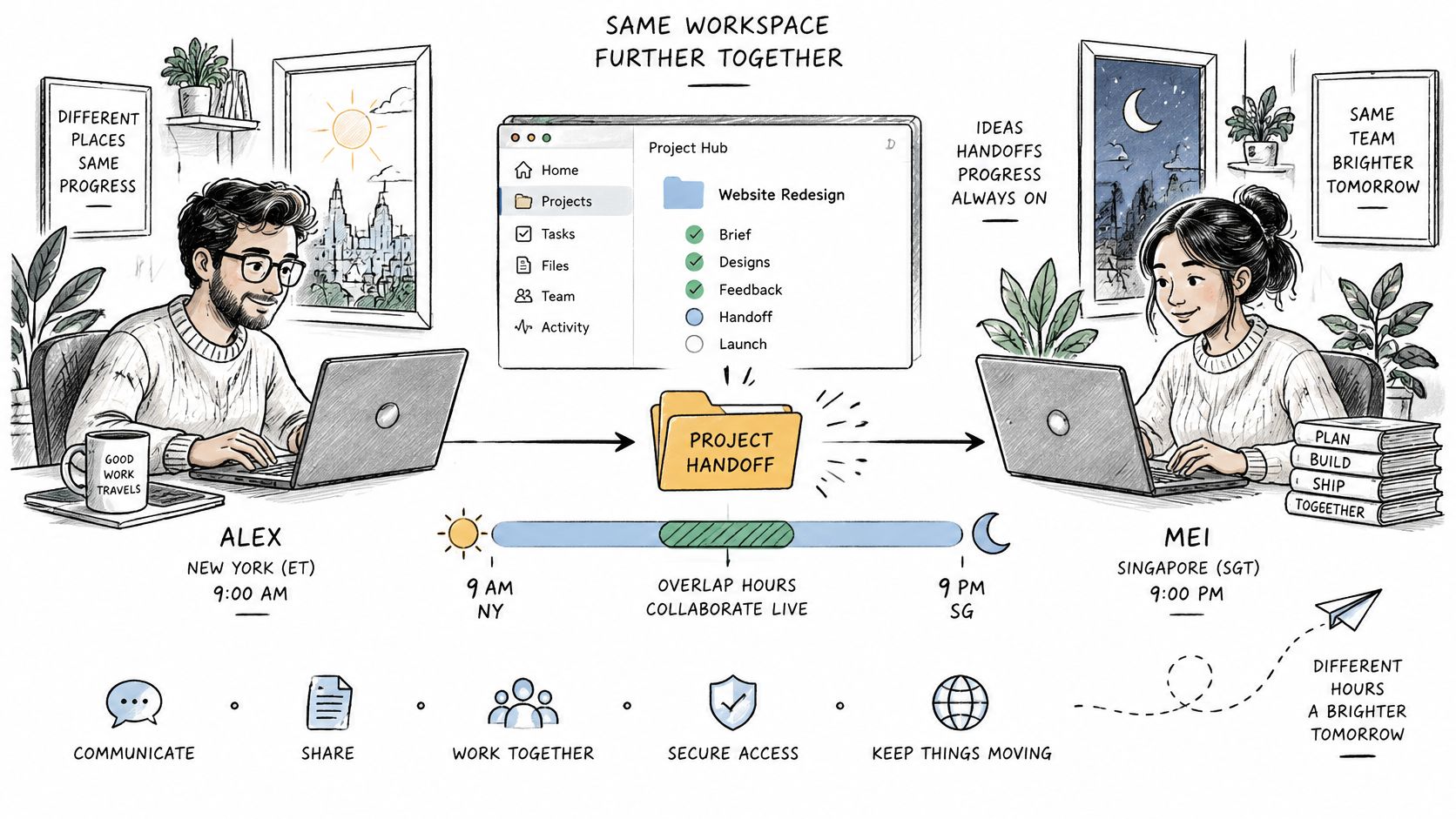
Use live overlap for decisions and asynchronous workflows for production. Design reviews, estimating clarifications, RFI decisions, and escalations need access to the right people; takeoffs, drafting revisions, model cleanup, and log updates can proceed independently when the inputs are complete.
Our professionals are based in Latin America, within one to three hours of U.S. time zones, and usually keep full U.S. business hours. Our project managers work inside Procore, Buildertrend, and Monday, overlap client working hours, and can join client calls.
Give Every Assignment a Clear Unblocking Route
IEEE Computer Society reporting on engineering teams found that abrupt remote transitions reduced productivity in some cases, with junior engineers particularly affected by difficulty obtaining technical help, while teams accustomed to cross-time-zone work adapted more easily. The practical lesson is to design access to expertise rather than assume shared hours are enough.
- Name the owner and reviewer. Make responsibility visible in the task record.
- Issue complete inputs. Include current drawings, references, markups, and known exclusions.
- Define done. State the checkable delivery standard.
- Set a question-response target. Match urgency to the work's criticality.
- Identify escalation. Name who decides when the usual reviewer is unavailable.
- Require a handoff note. Record completed work, open questions, file locations, and the next action.
- Review acceptance and turnaround. Discuss causes of rejection and delay, not just task counts.
Keep Files Controlled and Questions Visible
Most clients provide software licences so work stays in their systems, although some professionals hold their own. Use named accounts, project-appropriate permissions, approved storage locations, and an offboarding checklist rather than shared credentials or personal file transfers.
A year-long participant-observation study of remote software teams linked changed coordination, distrust, improvised communication, and reduced cohesion with misunderstandings and poorly defined tasks. It studied software rather than AEC firms, but the coordination risk is relevant when a drafter or estimator can't quickly reach an experienced colleague. Maintain a standing question channel and a named technical contact for each role.
Track first-pass acceptance, turnaround, blocked hours, RFI aging, and revision cycles. Define what each measures, then investigate the cause: a growing RFI backlog may reflect delayed design decisions rather than weak administrative performance. The objective is less senior time spent unblocking and repairing production, not a higher count of completed tasks.
The Takeaway
A remote staffing agency adds useful production capacity when the work has defined inputs, clear acceptance criteria, and an authorized reviewer. It isn't a substitute for licensed judgment, and a lower monthly invoice doesn't guarantee lower delivery costs. The arrangement succeeds when senior staff spend less time repairing work and more time making the decisions only they can make.
Before requesting a shortlist, decide which tasks can move remotely, who reviews each output, and which measures will show whether the arrangement reduces bottlenecks. Write the deliverable scope, run a paid exercise using your drawings or standards, and confirm employment, payment, replacement, and cancellation terms. Licensing, classification, and delegation rules vary by jurisdiction, so involve qualified counsel where needed.
Track first-pass acceptance and turnaround during the initial review period before expanding headcount. If output is sound but progress is slow, fix access and decision delays; if the work repeatedly misses a clear standard, address the fit rather than adding more supervision indefinitely.
HireArchitects connects U.S. architecture, construction, and design-build firms with vetted remote professionals from Latin America for drafting, estimating, BIM, design, and project coordination. Visit HireArchitects to discuss your deliverables, software stack, and review requirements before choosing a role.