No single MEP design firm suits every project, because the right choice depends on building type, project scale, geography, and how closely the design team must coordinate with architects and contractors. Say your owner's team has six proposals for a mechanical and electrical renovation, a permit deadline in eight weeks, and fees that look similar on page one. Picking the familiar name feels safe. It isn't a vetting method.
You're really testing whether a firm has designed this building type, in this jurisdiction, at this scale, with the delivery model you're using. That matters because MEP choices drive operating cost for decades. The International Energy Agency Energy Efficiency 2023 report states buildings accounted for approximately 30% of global final energy consumption in 2022, about 133 exajoules, and roughly 26% of global energy related emissions. Heating, cooling and hot water drive a large share of that use.
Use the seven profiles below as candidates to test, not verdicts. Match scope and footprint to your project, probe licensing and recent comparable work, test BIM and communication habits, and only then compare fees on equal scope.
1. Vanderweil
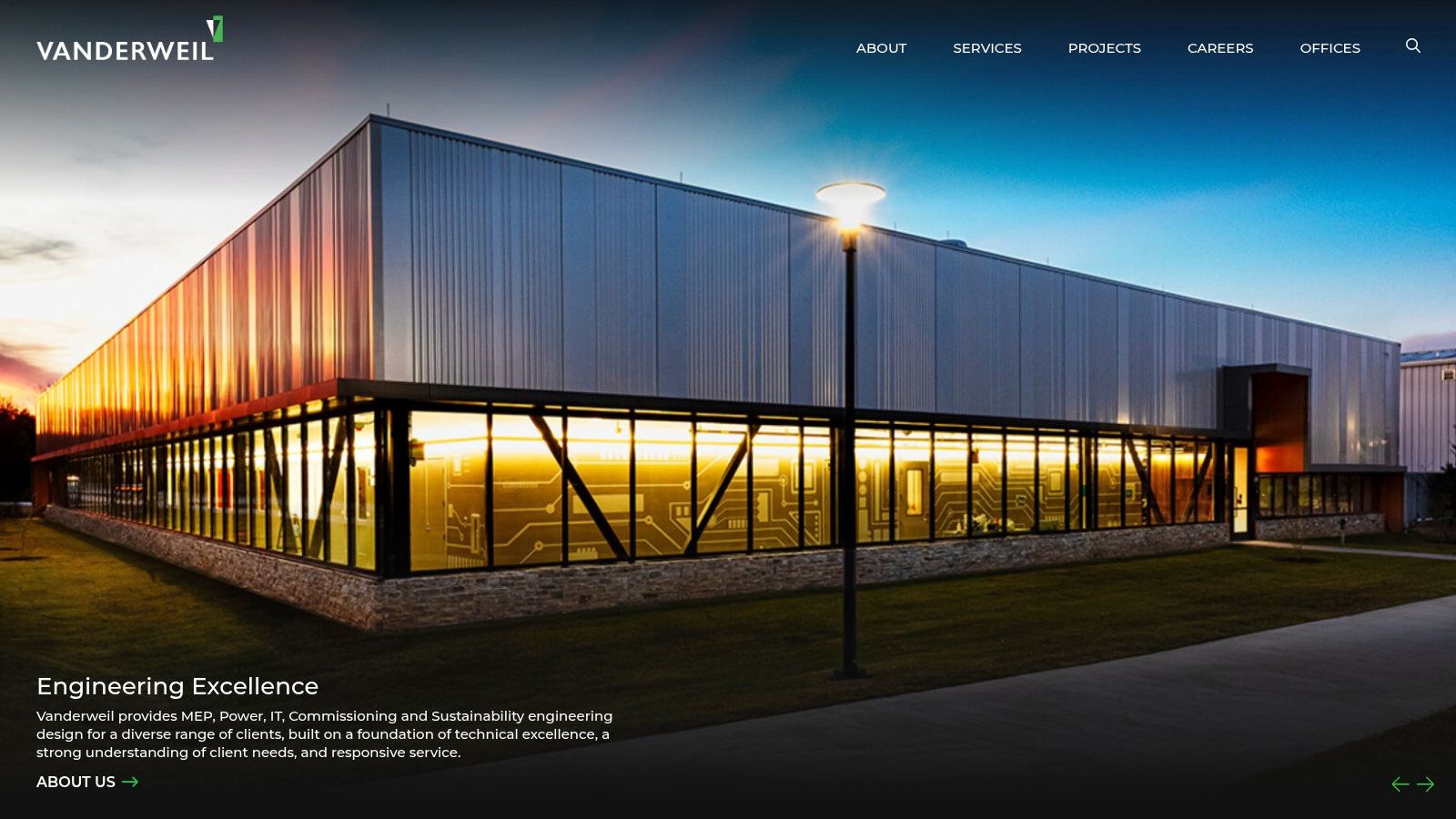
Start here when the building itself is technically demanding. Vanderweil provides mechanical, electrical, plumbing, and fire protection engineering alongside power, technology, sustainability, and commissioning, with offices in several U.S. cities. Its stated experience covers education, healthcare, laboratories, hospitality, government, and mission critical facilities, including research labs, cleanrooms, and central plants.
That breadth helps when systems interact, for example when lab exhaust, pressurization, standby power, and commissioning can't be designed in isolation. It can also be more firm than a small tenant improvement needs. Ask which office and which named engineers would staff your job, and whether those people carried a comparable facility through construction, not just design development.
How I'd test the fit
Give candidates an architectural and structural reference model with deliberate conflicts and incomplete equipment data. The Autodesk AEC Smart Market Brief reports BIM adoption at 52% for MEP engineers, compared with 80% for general contractors and construction managers, and 70% of MEP engineers view BIM as having high or very high impact on outcomes. Portfolio talk won't reveal whether a team can federate models, classify clashes, or respect clearances.
- Pros: Integrates multiple disciplines, suits complex facilities, varied building type experience
- Cons: Broad scope may exceed small projects, pricing needs project specific consultation
- Support option: If your engineer of record needs production help, review how to hire remote MEP designers under licensed supervision
2. Syska Hennessy Group
For an airport, hospital, courthouse, or distribution center, coordination risk often matters more than drafting speed. Syska Hennessy Group offers MEP design within a wider building systems practice that includes commissioning, fire and life safety, architectural lighting, information and communications technology, smart buildings, and sustainability. Its markets include aviation, healthcare, hospitality, higher education, commercial, and mission critical work.
The advantage is obvious on a project where lighting, low voltage, life safety, and HVAC controls all touch the same ceiling. One consultant coordinating those systems reduces handoffs. The trade off is equally clear. If you want a small local consultant who'll walk your site weekly with two principals, a large firm model may feel distant, and you'll need to pin down response times in writing.

Practical rule: Ask who owns clash resolution between disciplines, and how quickly that person can make a decision without escalating through three managers.
BIM based MEP coordination combines discipline models to find conflicts before installation, especially in ceilings, risers, and equipment rooms where space is tight. A peer reviewed study of BIM based MEP coordination describes using Navisworks to integrate models and detect clashes, and distinguishes clash avoidance, enhanced detection, and clash filtering. Ask Syska, or any large firm, to show a filtered clash report and explain which items were real constructability problems versus modeling artifacts.
Pros include coordination across specialist systems and public examples of complex facilities. Cons include a delivery model that may not suit small local work, and unpublished, scope dependent pricing.
3. RMF Engineering
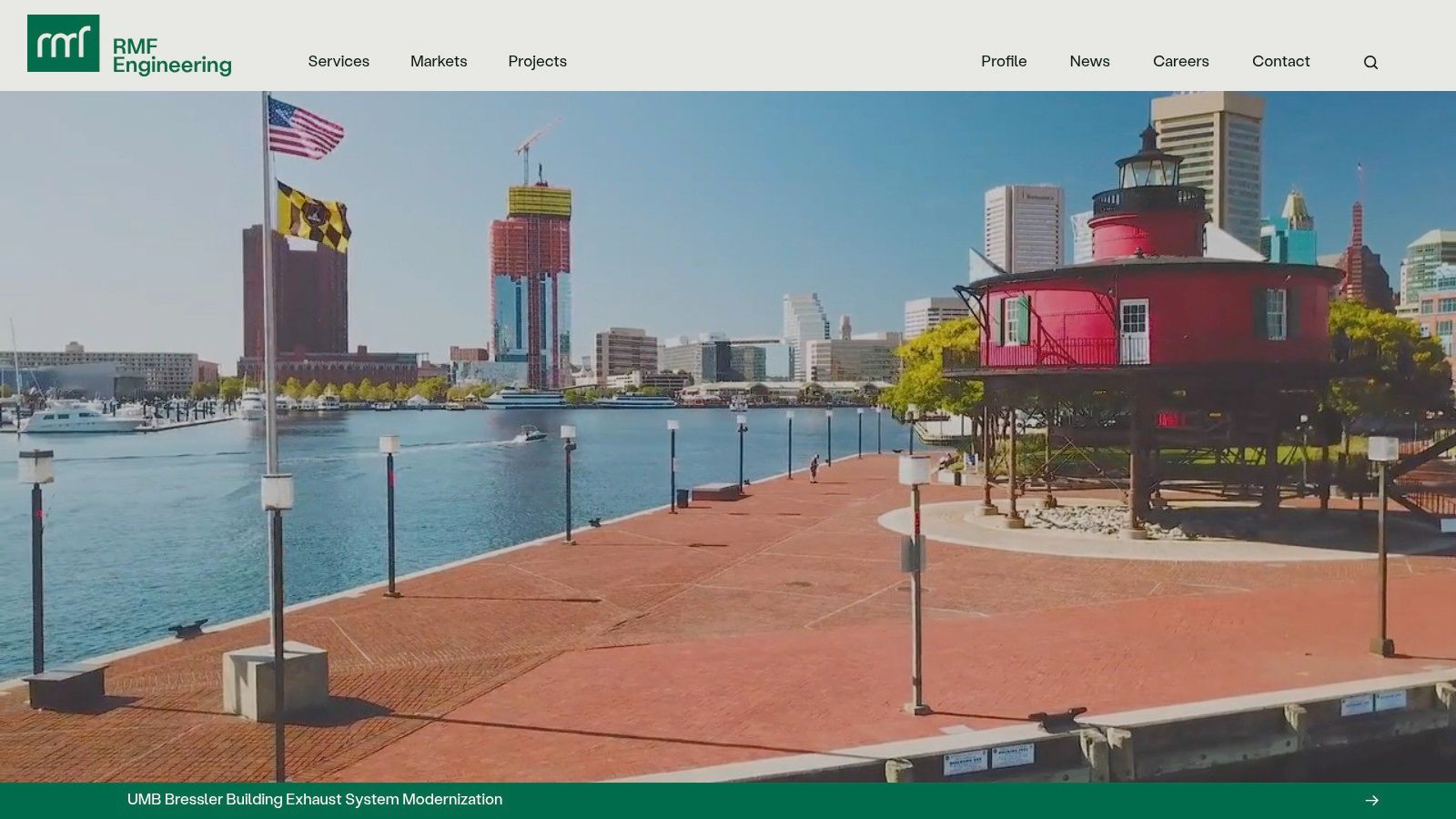
Campus owners should look carefully at RMF Engineering. The firm provides MEP building engineering plus district energy, thermal and electrical utilities, commissioning, construction quality management, energy, and decarbonization services from offices across the country. It highlights healthcare, higher education, federal, civic, and science and technology projects, for new construction and retrofit.
That utility depth separates it from a conventional building MEP consultant. If your project involves a central plant, campus distribution, or phased replacement while buildings stay occupied, ask RMF to walk you through a similar sequence and its failure points. If you're doing a small tenant improvement, that infrastructure focus may not translate into value, and you could compete for attention with larger institutional clients.
Questions on workflow
Don't stop at software names. A European survey of 186 construction sector SMEs reported in the Journal of International Technology and Information Management study found 77% used advanced digital tools such as BIM, 3D modeling, thermal scanning, GIS, or collaborative platforms, while generic tools were more popular than construction specific platforms. Tool ownership doesn't prove a reliable information flow.
- Model exchanges: How often, in what format, and through which common data environment
- Issue tracking: Who codes, ages, and closes open clashes and late inputs
- Team structure: How design connects to the people covered in this guide to preconstruction team roles and hiring timing
Pros include institutional and campus strength and support from evaluation through construction related services. Cons include less apparent fit for small tenant work and no public fee schedule.
4. AlfaTech
AlfaTech suits owners whose MEP scope bleeds into process, technology, or smart building design. It provides mechanical, electrical, plumbing, and fire protection engineering with process engineering, technology design, architectural lighting, sustainability, and smart building services. Markets include advanced technology, mission critical, science and technology, transportation, education, workplace, and mixed use, delivered through design, design assist, and design build approaches.
Consider a laboratory or advanced technology fit out where process piping, tool hookups, and controls drive the mechanical design. A generalist commercial firm may model it neatly and still miss the operational logic. AlfaTech's specialized examples make it worth interviewing for that work. For a straightforward office renovation, the added disciplines may add coordination you don't need.
Capacity is the sharper question. Coverage of MEP hiring in LVI Associates industry insights describes shortages concentrated in electrical systems, digital infrastructure, and mechanical engineering, and notes about 78% of markets reported labor shortages or severe shortages in a global survey covering 112 markets across 44 countries. Employers increasingly want engineering judgment combined with digital delivery skill.
So ask which skills are scarce on your project. Is the bottleneck power distribution, commissioning coordination, BIM governance, or drawing production? A firm that is honest about that distinction, and names the senior person covering it, is safer than one promising headcount.
Pros include combined engineering and technology design and laboratory experience. Cons include unnecessary breadth for simple MEP only work, and fees, availability, and regional capacity you'll need to confirm directly.
5. M/E Engineering, now part of Salas O'Brien
Ownership changes deserve direct questions, not assumptions. M/E Engineering provides MEP and fire protection design, commissioning, central plant engineering, computational fluid dynamics, and sustainable engineering across healthcare, education, research, industrial, and residential work. It announced it joined Salas O'Brien in October 2025 and says offices remain under the same leadership, concentrated in New York State and the Northeast.
That CFD capability matters when airflow is the problem, for example in a lab, atrium, or space with stratification complaints. Central plant and commissioning depth also help owners who want performance verified, not just designed. Before signing, clarify the contracting entity, insurance, licensing, and whether your project team stays intact. A wider parent may bring resources, but it doesn't guarantee your original contacts remain accountable.
A low clash count doesn't make a package construction ready. Valves no one can reach and equipment no one can service pass clash detection easily.
That point is illustrated in a 2025 BIM implementation guide, which documents correct 3D layouts alongside conflicting 2D documents that caused incorrect MEP installation, and cites a federated model with 115 structural and MEP clashes, including 32 major clashes. Ask how senior engineers check model to sheet consistency, clearances, slopes, penetrations, and connected loads before sign off. Owners coordinating that review may also use independent project management advisors.
Pros include airflow and central plant specialization. Cons include a regional footprint and post acquisition details to confirm.
6. MPW Engineering

Multi state commercial work raises a different test. Tulsa headquartered MPW Engineering provides mechanical, electrical, plumbing, and fire protection design for commercial clients. Its website says the firm is licensed in all 50 states and has expertise across 13 specialties, with published project examples and a direct consultation request path.
For a rollout program, one firm holding design consistency across states is attractive. It reduces relearning your standards in every market. Don't mistake a license map for local capacity, though. Licensing doesn't prove familiarity with a specific authority having jurisdiction, utility provider, or energy code amendment. Ask for the engineer who'll stamp in your state, their recent permits there, and who attends local review meetings.
What coordinated production should look like
- Federated model: Architectural, structural, and MEP models combined on a fixed schedule
- Severity rules: Hard clashes separated from clearance, access, and maintainability conflicts
- Revision control: Named ownership for updates between issuances
A 2025 research report on model coordination in Navisworks reports an estimated 22% to 35% reduction in piping dismantling and reinstallation compared with traditional CAD based approaches in the studied workflow. Treat that as project specific, not a guaranteed saving, but it shows why coordination management deserves its own line in a proposal.
Pros include multi state coverage and several disciplines under one firm. Cons include building type experience you must verify and no public pricing.
7. MEP Designs, Inc.
Regional firms earn their place on a shortlist when local knowledge and direct access matter more than national scale. Manassas, Virginia based MEP Designs, Inc. offers mechanical, electrical, and plumbing design, commissioning, and consulting for new construction and renovation. Its project types include commercial, government, institutional, and large residential buildings, and it states licensing in Virginia, Maryland, Washington, DC, West Virginia, North Carolina, and New Jersey.
Its consulting scope includes feasibility, value engineering, energy analysis, and code analysis, and its website identifies small business certifications and offers a quote request option. For a Mid Atlantic renovation where existing conditions are uncertain, that feasibility work can be more valuable than jumping straight to construction documents. Confirm current licenses for your jurisdiction, construction administration availability, and recent work in your exact building type, because the regional model depends on the local team's depth.
Cost context helps when you weigh in house versus consultant capacity. The U.S. Bureau of Labor Statistics May 2023 data for NAICS 541330 Engineering Services reported 1,134,700 workers with an annual mean wage of $101,660, and mechanical engineers held 53,370 positions with an annual mean wage of $104,470. Specialist staff are expensive to carry through uneven workloads.
Pros include a defined licensing region and consulting beyond design. Cons include limited geographic reach and pricing that requires direct confirmation.
How the seven MEP design firms differ on disciplines, services, footprint, and pricing visibility
None of the seven firms publishes a fee schedule, so pricing is the weakest screening tool in this table. The stronger signals are footprint and service breadth.
| Item | Core Disciplines | Notable Additional Services | Stated Markets or Footprint | Pricing Published Online |
|---|---|---|---|---|
| Vanderweil | Mechanical, electrical, plumbing, fire protection | Power, technology, sustainability, commissioning | Multiple U.S. cities; education, healthcare, labs, hospitality, government, mission-critical | Not published; project-specific consultation |
| Syska Hennessy Group | MEP design | Commissioning, fire and life safety, lighting, ICT, smart buildings, sustainability | Aviation, healthcare, hospitality, higher education, commercial, mission-critical; broad office presence | Not published; depends on project scope and location |
| RMF Engineering | MEP building engineering | District energy, utilities, commissioning, energy modeling, decarbonization | U.S. offices; healthcare, higher education, federal, civic, science and technology | No public fee schedule |
| AlfaTech | MEP and fire protection | Process engineering, technology, lighting, sustainability, smart buildings | Advanced technology, mission-critical, science and technology, transportation, education, workplace, mixed-use | Not stated |
| M/E Engineering, now part of Salas O'Brien | MEP and fire protection | Commissioning, central plants, CFD, sustainable engineering | New York State and Northeast; healthcare, education, research, industrial, residential | Not stated |
| MPW Engineering | Mechanical, electrical, plumbing, fire protection | Commercial engineering across 13 specialties | Tulsa-headquartered; website states licensing in all 50 states | No public pricing |
| MEP Designs, Inc. | Mechanical, electrical, plumbing | Commissioning, feasibility, value engineering, energy and code analysis | Mid-Atlantic region: VA, MD, DC, WV, NC, NJ; commercial, government, institutional, large residential | Not stated; requires direct confirmation |
Read the footprint column as a licensing question, not a marketing one. MPW claims licensing in all 50 states from a Tulsa base, M/E Engineering concentrates in New York and the Northeast, and MEP Designs lists six Mid-Atlantic jurisdictions. A national claim still needs a named engineer who stamps in your state, and a regional claim only holds if the local office has depth in your building type. M/E Engineering's integration into Salas O'Brien is the kind of ownership change that can shift which entity contracts and who answers permit comments.
The services column separates firms that stop at MEP documents from firms that carry adjacent scope. RMF runs district energy and decarbonization work, M/E lists central plants and CFD, AlfaTech adds process engineering and smart buildings, and MPW describes commercial engineering across 13 specialties. I'd treat every row here as a claim to test against a comparable past project rather than a settled capability.
Turning a Shortlist Into a Confident Engagement Decision
Define the scope before you request fees. Write down building type, square footage, systems in scope, delivery model, permit jurisdictions, BIM level, and whether you need energy modeling, commissioning, or construction administration. A low fee against a vague scope usually means exclusions you'll buy back later as additional services.
Then test experience with evidence. Ask for three projects of similar type, scale, and location from the last few years, and call the architect or owner, not just the references the firm leads with. Confirm who holds the Professional Engineer license in your state, who stamps, and who reviews calculations. For firms with ownership changes or national licensing claims, verify the contracting entity and the local person accountable for permit comments.
Test collaboration habits next. Request a redacted clash report, an RFI log turnaround commitment, and the firm's revision control process. Ask how it checks equipment access, maintenance clearances, slopes, and specification alignment before issuance. If a candidate can't describe its QA beyond running clash detection, keep looking, whatever the fee.
Compare proposals on scope clarity. Line up deliverables by phase, meeting counts, site visits, resubmittals, and assumptions about owner furnished information. The cheapest proposal that excludes coordination meetings will cost you time in the field. I'd pay more for a firm that names its team, caps response times, and prices alternates transparently.
Staffing can supplement, not replace, that decision. Remote drafters and BIM coordinators can handle documentation, revisions, and model production while senior engineers keep design decisions. Classification still needs care, because the U.S. Department of Labor misclassification guidance states working remotely doesn't by itself determine independent contractor status, and control over how work is performed remains relevant. Get legal and tax advice for cross border arrangements.
If your engineer of record needs added production capacity, you can review HireArchitects remote MEP designer placements on monthly terms, applying the same practical tests you'd give any hire. Code sign off and engineering responsibility stay with your licensed engineer.
If your shortlisted MEP design firms have the engineering covered but your team lacks drafting, BIM coordination, or estimating capacity, HireArchitects places vetted remote professionals from Latin America who work U.S. hours under your licensed staff. You interview candidates first, test them on real tasks, and scale monthly as workload shifts. Visit HireArchitects to discuss the roles your project needs.