You're three weeks into a mechanical retrofit, the permit reviewer has just returned a second round of comments, a long lead air handler still doesn't have an approved submittal, and your principal is asking why the schedule shows the job finishing on time. Nobody on the team is idle. The problem isn't effort, it's authority. Decisions are waiting because no one wrote down who can approve what, which record carries a change, and where a late answer stops being an administrative slip and starts moving the finish date.
That's the core of project management engineering. It's not software, and it's not a Gantt chart you print for a client meeting. It's the discipline of giving every decision a named owner, every activity a place in a linked plan, and every change a traceable path through scope, cost, and time. When those three things are clear, a coordinator or remote specialist can carry a large share of the control work. When they're fuzzy, senior engineers spend their days chasing logs while real design decisions sit unmade.
What Project Management Means on an Engineering Job
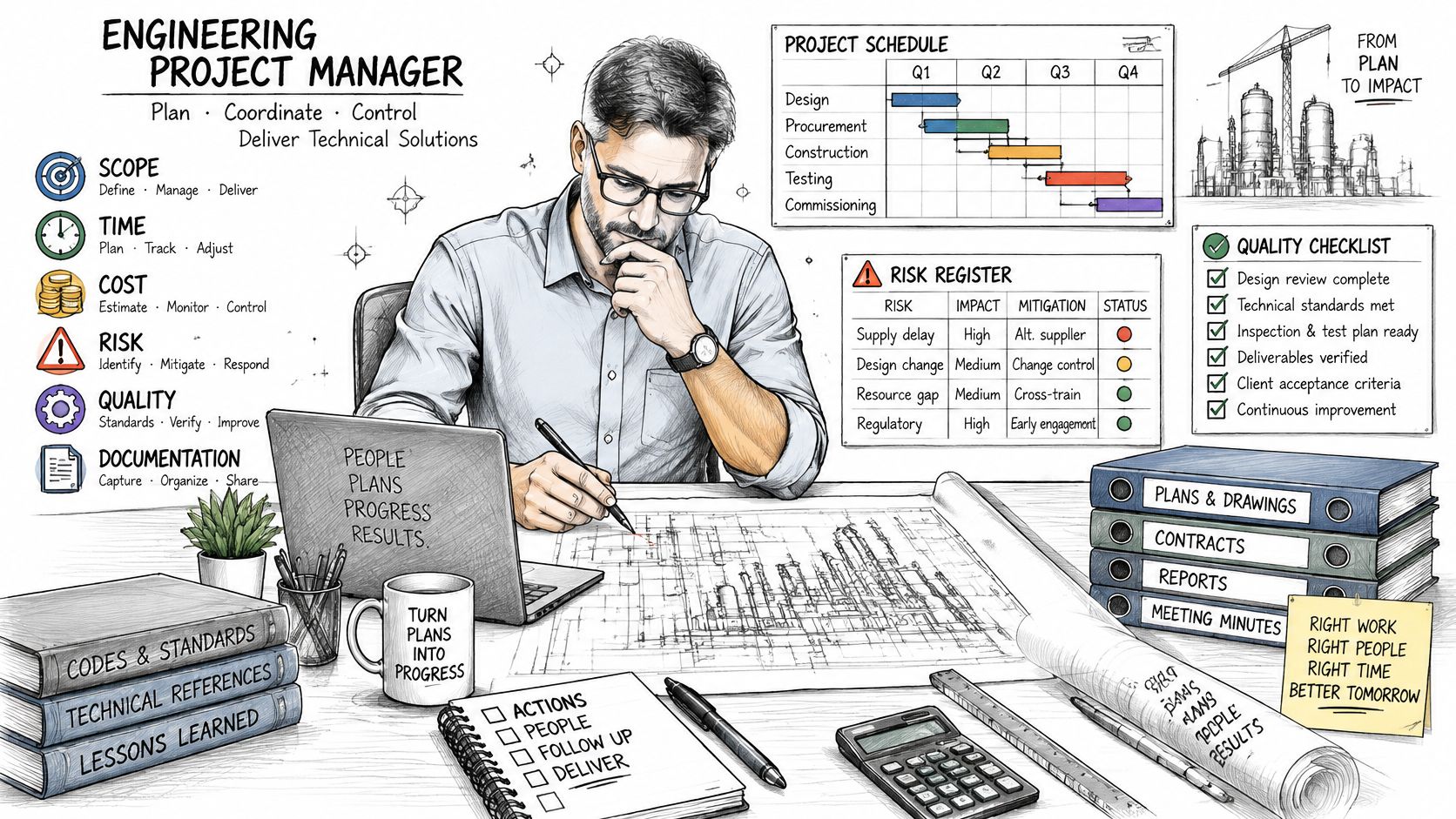
Project management engineering plans, coordinates, and controls the scope, time, cost, risk, quality, and documentation of technical work that has to be designed, reviewed, and approved before anything gets built. Think of it this way. The design engineer decides what the structure or system must do. The project manager decides when each drawing, review, approval, and purchase must happen so the team reaches that result on the date and budget you promised.
Three Roles Teams Keep Blurring
Engineering management leads technical staff and design quality over time. It sets standards, mentors engineers, and owns how the technical work gets done. Project management is narrower and job specific. It runs controls and coordination for one defined scope, from baseline to closeout. Construction management directs field work, sequencing trades, managing access, and responding to site conditions.
A small firm may put all three hats on one person. That makes the boundaries more important, not less, because the same person has to know which decision they're making and in what capacity.
The modern foundation is older than most software vendors admit. According to the history of the Critical Path Method, Morgan R. Walker of DuPont and James E. Kelley Jr. of Remington Rand created CPM in 1957 to model engineering work as a network of interdependent activities, identifying the sequence that sets the minimum completion time. That history also notes that in a 1974 study of the 400 largest U.S. construction firms, more than 80% of the 235 responding companies used critical-path methods, compared with 47% before 1965. Schedule logic, dependency analysis, and float management still rest on that idea.
Who Owns Which Decisions on an Engineering Team
Most control failures I've seen start with unclear authority. A project manager absorbs document control because nobody else picks it up. A coordinator answers a field question that belongs to the engineer of record. A principal learns about a price impact after the client has already been told the change is fine. The work isn't hard. The ownership is missing.
A decision ownership matrix fixes that in one page. Each row names a role, what it owns, what it shouldn't decide alone, and where it escalates. Adapt the table below to your contract and firm size before the next job starts, not after the first dispute.
| Role | Owns | Does not decide alone | Escalates to |
|---|---|---|---|
| Principal or project executive | Contract terms, fee, staffing levels and client relationship | Scope changes that alter price or duration | Client or owner representative, as the contract directs |
| Licensed architect or engineer of record | Design intent, code compliance and sealed documents | Schedule sequencing and document logs | Principal, for contract or fee effects |
| Project manager | Schedule baseline, budget control, change routing and team workload | Design judgments and code interpretation | Principal, for cost or time impacts |
| Project coordinator | RFI and submittal logs, transmittals, meeting minutes and due-date tracking | Approving substitutions or scope changes | Project manager |
| Scheduler | Schedule network, periodic updates and look-ahead reports | Changes to logic or durations without approval | Project manager |
| Estimator | Quantity takeoffs, unit-rate databases and bid packages | Final bid pricing and exclusions | Principal, before submission |
How to Read the Matrix on a Live Issue
Say a contractor proposes substituting a louver for the specified model. The coordinator logs it, attaches the product data, and routes it with a due date. The project manager checks whether the lead time helps or hurts procurement and whether the change affects other trades. The engineer of record decides whether the substitute meets design intent and code. If it changes price or duration, the principal takes that to the client before anyone commits.
Notice what doesn't happen. The coordinator doesn't approve it because it looks equivalent. The project manager doesn't wave it through because it saves two weeks. Speed comes from clear routing, not from shortcutting the licensed decision.

Practical rule: If a decision can change a sealed drawing, the contract sum, or the completion date, it doesn't close at coordinator level.
On a residential remodel, one person may be principal, estimator, and project lead at once. Write the matrix as a list of decisions rather than job titles in that case. You'll still catch the moment where you're approving your own pricing or sealing a change you also scheduled.
This is also where outside support fits cleanly. A remote project management specialist can own logs, routing, follow up, and schedule updates inside written limits, while your licensed staff keep design and contract authority. Try the test before your next team meeting. Pick three open issues from your current job and assign each to a row. If any issue has no row, or two owners, you've found your next delay.
Building a Schedule on a Linked Work Breakdown Structure
A schedule built from a task list will always drift apart from your estimate and your progress reports. Build it instead on one product oriented work breakdown structure, or WBS, that scope, estimating, scheduling, and progress all share. The U.S. Government Accountability Office cost estimating guide recommends that the cost estimate WBS match the schedule and earned value WBS, with each element documented in a WBS dictionary and updated as project definition evolves. The dictionary states what each element includes and excludes, so two people in different offices don't price or schedule the same code differently.
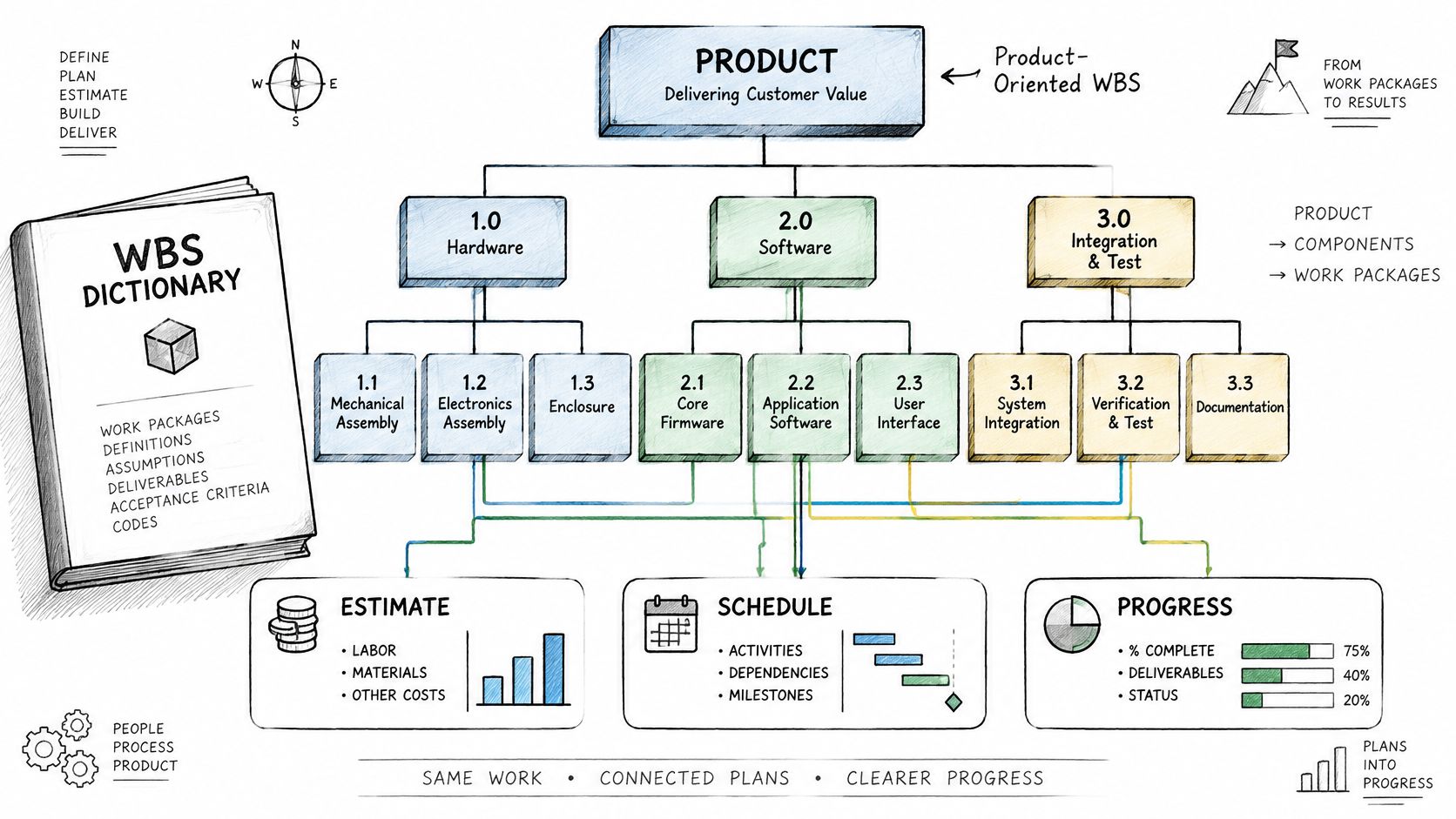
Take a revised mechanical room layout as the test. If the drawing package, the two procurement items it affects, and the installation package all carry the same WBS code, you can trace one revision to its budget, its dates, its crews, and its earned progress in minutes. If each lives in a separate spreadsheet with its own naming, you'll rebuild that chain by hand every time the client asks what changed. That tracing ability is the whole point. It's also what lets remote staff update controls reliably, because standardized codes remove ambiguity across time zones and platforms.
Six Steps That Turn the WBS Into a Schedule
- Break scope into activities: Split each WBS element into activities with a clear start, finish, and single owner. If you can't name the owner, the activity is too broad.
- Assign predecessors and successors: Link design reviews, permits, procurement, fabrication, delivery, installation, and testing with explicit network logic, not just start dates typed into cells.
- Set durations from evidence: Base durations on past productivity for similar work and write down the assumptions, including crew size and access conditions.
- Load the resources: Assign labor, equipment, and materials so the plan shows whether the people and gear exist in the weeks you need them.
- Baseline it: Lock the agreed plan. Without a baseline, every update becomes a fresh opinion and variance disappears.
- Update with facts: At each cycle, record actual starts and finishes, remaining duration, and the reason for every variance, then reforecast through the logic.
Why Logic and Float Deserve Your Attention
The GAO schedule assessment guidance requires a logically linked network, a validated critical path, reasonable total float, horizontal and vertical traceability, resource loading, and updates using actual progress and logic. Float is the slack an activity can absorb before it pushes the finish date. The critical path is the longest chain through the network, and it has no slack to give.
Design and authority review float usually disappears first, because teams spend it on internal rework before the package ever reaches the reviewer. By the time comments return, the chain of reviews is critical and every correction round lands directly on the permit date. Watch float erosion in your updates, not just milestone dates. A milestone that still shows green while its float shrinks every period is already in trouble.
The table below shows common planning patterns. Treat it as a checklist for where logic tends to break, not as a benchmark for durations on your job.
| Phase | Typical predecessors | Common delay driver | Float to watch |
|---|---|---|---|
| Design development | Program approval and site survey | Client decisions and design rework | Low float when reviews are chained |
| Authority review and permitting | Complete permit drawings | Review cycles and correction rounds | Often on the critical path |
| Long-lead procurement | Approved specifications and submittals | Fabrication and delivery lead times | Watch the order date, not only the delivery date |
| Shop drawings and fabrication | Approved submittals | Review backlog for shop drawings | Moderate float, sensitive to late approvals |
| Field installation | Delivery, site access and preceding trades | Access windows and sequencing conflicts | Set by crew availability |
| Testing and acceptance | Installation complete and inspections scheduled | Failed tests and missing documentation | Usually little or no float at handover |
Sorting Variance Before You React
When progress slips, sort the cause before you choose a response. The GAO approach isolates variances into scope growth, productivity, sequencing, and resource availability, and each one needs a different fix. Scope growth needs a change decision and possibly added fee or time. Productivity loss needs crew, method, or supervision changes. A sequencing problem needs logic repair. A resource shortage needs staffing or procurement action.
Teams waste weeks applying the wrong fix. Adding overtime to a sequencing problem just pays people to wait faster. Measure progress against objective outputs instead of percent complete guesses. Count approved drawing packages, coordinated model zones, released submittals, or installed quantities tied to the WBS. Those outputs either exist or they don't, which makes the update conversation shorter and more honest.
A late submittal isn't an administrative problem. In a linked schedule it's a procurement, labor, and completion problem with a date attached.
Cost Control on the Same Spine
Cost control works best when it runs on the same codes. Build in sensitivity and uncertainty analysis on the items that can swing the budget, compare your number against an independent estimate where the stakes justify it, and update from actual costs and approved changes rather than original assumptions. For larger or riskier work, run what if scenarios on the uncertain activities, such as authority review duration, long lead equipment, or design rework, and see which ones consume float or contingency first.
There's a sensible exception for small work. A minor remodel may not justify formal control accounts or earned value tracking. It still needs consistent codes across the estimate, schedule, and change log. That consistency costs almost nothing at setup and saves hours the first time the owner asks why the price moved.
Running RFIs, Submittals and Change Orders Without Mixing Them Up
These three records get confused constantly, and the confusion is expensive. An RFI asks for clarification of the contract documents. A submittal shows how the contractor intends to carry out the design, through shop drawings, product data, or samples. A change order records an agreed change to the work and its effect on cost or time. Different purpose, different authority, different consequences.
| Record | Purpose | Usually started by | Who responds | Coordinator role |
|---|---|---|---|---|
| RFI | Clarify the contract documents during construction | Contractor or field team | Design professional, as the contract directs | Log, classify, assign and track the response deadline |
| Submittal | Review how the contractor intends to implement the design | Subcontractor or supplier, routed by the contractor | Design professional reviewer | Maintain the submittal schedule, route packages and track review periods |
| Change order | Record an agreed change with its cost and time effect | Proposed by either party after a documented trigger | Parties the contract authorizes to agree | Prepare the record, route for signature and update the baseline only after approval |
The RFI Workflow That Holds Up
Start by screening whether the question is genuinely a clarification request. Some RFIs are really substitution proposals, schedule complaints, or attempts to shift design responsibility. Identify the drawing, specification, or submittal involved, assign one owner, set the contractual response deadline, and log it the day it arrives. When the answer comes back, link it to the schedule activity it affects and to any change record it triggers.
The workload justifies that discipline. A construction industry analysis of Navigant data reviewed 1,083,807 RFIs across 1,362 projects and found the projects averaged 796 RFIs, with an estimated eight hours to answer each one. Your job won't match that average, but the scale explains why intake and tracking can't live in someone's inbox. A coordinator who classifies, assigns, and chases responses against deadlines protects design hours for the questions that need an engineer.
Submittals Need Their Own Schedule
Build a submittal schedule organized by specification section and numbered in sequence, then fold submission dates, review periods, and installation timing into the construction schedule. Long lead items go first, not in spec order by habit. If the review period isn't in the schedule, the procurement chain behind it is fantasy.
Track review status. A package sitting with the wrong reviewer, or returned for correction without a resubmittal date, consumes fabrication time every day it sits. The coordinator owns that visibility. The design professional owns the review judgment.
The Line You Don't Cross
A clarification answer that changes scope, price, safety, or duration isn't a clarification anymore. It has to move into a formal change document agreed by the parties the contract names, and the baseline schedule and budget update only after that approval. Coordinators prepare and route that record. They don't authorize the field work.
Forms and response deadlines vary by contract, so confirm them against your agreement rather than copying another project's habits. What's consistent everywhere is the separation. Keep three registers, three workflows, and three levels of authority, and you'll avoid the most common documentation dispute on engineering jobs.
Technical Coordination and Project Document Control
Coordination usually fails from missing rules, not missing software. Teams buy a common data environment, share models on day one, and then discover that nobody agreed on naming, ownership, or who can edit what. Write the rules down before the first model is shared. You'll spend an hour doing it and save that hour every week.
Rules to Set Before Anyone Shares a Model
- Model ownership: Name who owns each model and who can issue it, so two disciplines don't edit the same file toward different ends.
- Naming and standards: Fix file naming, title block, layer, and sheet standards, plus who holds edit rights in each area.
- Units and codes: Confirm imperial units, CSI division organization, and whether IBC or IRC requirements govern the job.
- Issue discipline: Run clash reviews from issued models and reports, give each clash an owner and due date, and close resolved items in the same log.
That context matters even more with distributed teams. Our remote professionals have worked on US projects and understand US construction methods, imperial units, CSI divisions, and IBC/IRC requirements, but every firm still has its own sheet standards and review habits. State yours explicitly at kickoff instead of correcting files for a month.
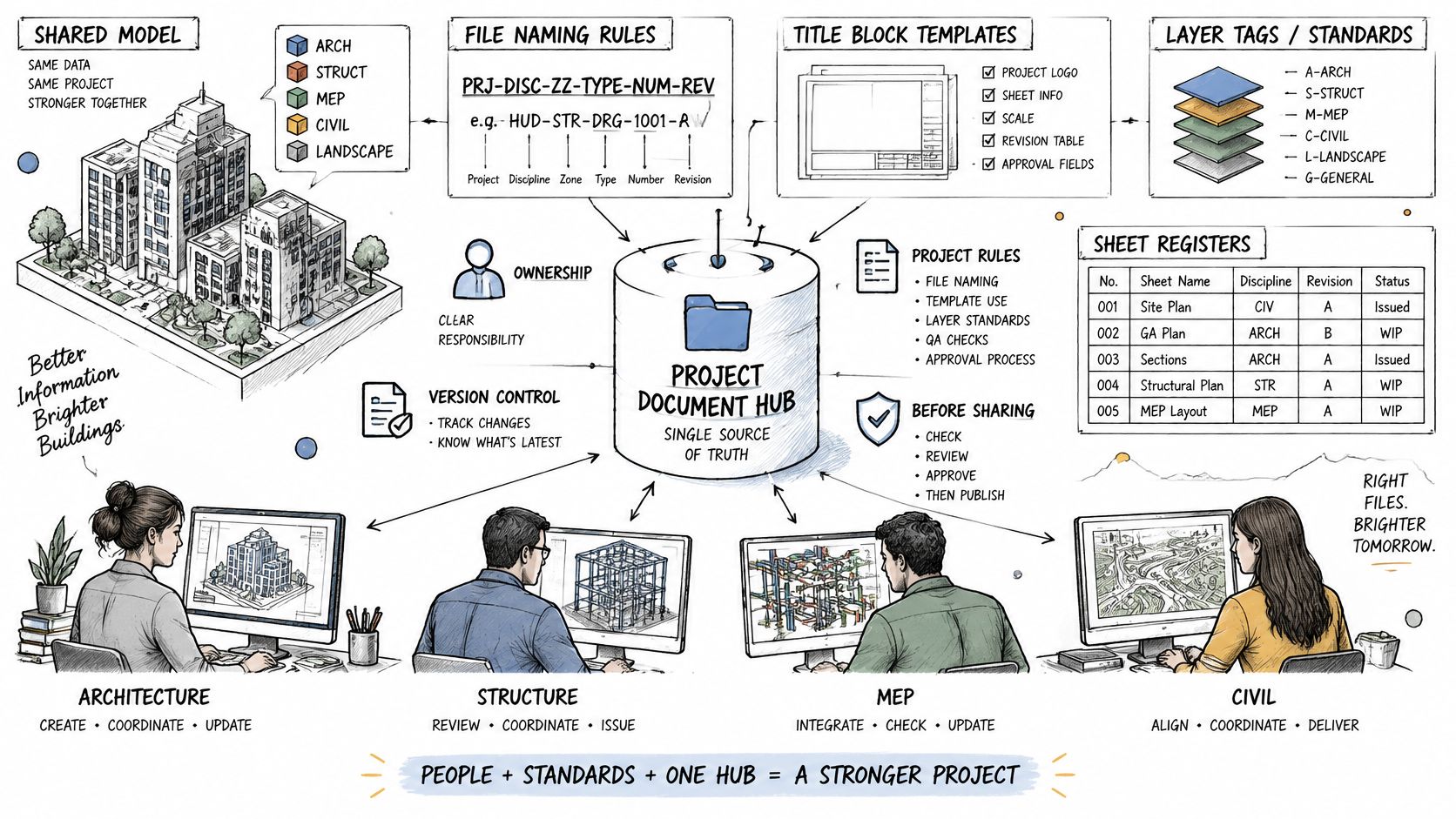
Add pre-issue checks on units, sheet numbers, and revision clouds. A model can be clash free and still go out with the wrong revision on half the sheets. Then set a fallback for the day the platform is down or a file won't open. Name who approves a temporary exchange by email or PDF, and how that file gets back into the record set afterward. Uncontrolled workarounds are how two versions of the truth start circulating.
Access is part of the plan too. Most firms provide software licences for their remote hire, such as AutoCAD, Revit, Bluebeam, Procore, or takeoff software, though some professionals hold their own licences. Client file access terms often decide who can work from where, so confirm those terms before you promise a client a staffing setup. Our guides to project management documents cover the record types that typically need those access decisions.
Document Control Extends the Same Discipline
Keep a register of every issued document, transmittals that record what was sent, to whom, and why, and one current record set that the field can trust. Superseded drawings should be visibly marked and hard to grab by mistake. At the end, assemble the closeout package of as built records and operation materials while the team still remembers where things are, not six months later.
Retention periods and closeout obligations come from your contract and jurisdiction, so confirm them with counsel or the client's document controls group. Within those limits, remote coordinators can standardize file hygiene, markups, and transmittals very effectively. Design decisions and code sign off stay with your licensed reviewers, exactly as the ownership matrix says.
Risk Registers and Early Warning Signs
Many firms keep a risk register that's really a report. Someone builds a thorough list at kickoff, formats it nicely, and never opens it again until a risk has already happened. A register only earns its place if it's a working list that changes behavior before the damage lands.
Each entry needs the risk, its cause, the schedule or cost activity it touches, a rough likelihood and impact, an owner, a response, and a review date. Missing any one of those, the entry is decoration. Engineering jobs supply familiar candidates. Long lead equipment whose fabrication time exceeds the plan. An authority review that returns comments twice. A field access window that depends on another trade finishing first. Design rework caused by late coordination between disciplines.
Triggers Tell the Owner When to Act
A risk without a trigger forces someone to guess when concern becomes action. Define the signal in advance:
- Supplier trigger: The vendor revises a lead time after the order date, so procurement escalates the same week, not at the next monthly update.
- Review trigger: A comment cycle runs past what the schedule allowed, which starts a conversation about resequencing or added review support.
- Decision trigger: A client decision waits beyond the agreed period, and the project manager issues a dated notice of schedule effect.
- Access trigger: Another trade changes its crew schedule around shared access, prompting a look ahead revision.
- Coordination trigger: Clash counts rise in one model zone after a design change, so that zone gets a focused review before fabrication.
Keep the register pointed at the records you already run. It should reference the relevant schedule activity, submittal, or change log entry rather than repeating their detail. Two systems tracking the same fact will disagree within a month.
A risk on the register without a trigger, an owner, or a review date isn't being managed, however complete the list looks.
Set escalation thresholds with the principal at the start, because they vary with project size, contract type, and client expectations. Decide what size of float loss, cost exposure, or decision delay forces a call upward. I would rather have a short register reviewed every update cycle than an exhaustive one nobody trusts.
Deciding Whether to Build or Outsource Project Controls
Start with the symptoms, not the org chart. Senior staff are spending hours on logs and follow up instead of design review. The schedule only gets updated before client meetings. Rework happens but never gets recorded, so you can't tell whether you have a coordination problem or a staffing problem. Those are overload signs, and they mean the control work needs a real owner.
Three Models Worth Comparing
An in house hire gives you daily presence and firm knowledge, but you carry the full cost through slow periods and the recruiting risk up front. A part time or remote specialist embedded in your team adds control capacity without a permanent headcount, provided the hours overlap and the authority limits are written. Project based support suits a single job with a defined end, though you lose continuity when it closes.
Score each option on the same criteria. Skill fit for your project types. Hours overlap with your team, because our remote professionals usually keep full US business hours so they can join meetings, bid reviews, and site calls live. Access to your software inside the client's contract terms. Control of confidential files. And cost predictability across a full year, not just the first month.
Remote staff supplied through a staffing provider are one version of the second model. Judge any provider on those same criteria rather than on a pitch. Talking with experienced project management advisors can help you scope the role, but the decision should rest on evidence you generate yourself.
Let a Practical Test Settle It
Our practical test for project managers is a schedule or RFI exercise run on a past project. Hand the candidate or provider the records from a job you already finished, time the work, and check the output against what happened. Did they find the logic break? Did they classify the RFI that was really a scope change? That result predicts performance better than any interview.
Many firms start part time and expand once the workflow is proven. That's a sound sequence. Review the choice as volume changes, because the right answer at three active jobs is rarely the right answer at eight.
The Takeaway
Strong project management engineering rests on three habits. Each decision has a named owner with clear limits. Each change traces through a common work breakdown structure into budget, dates, and progress. Each risk carries a trigger and a review date that force action while you still have options.
Licensed professionals keep design judgment and sealed documents. Project managers and coordinators keep the schedule, records, and routing that bring those decisions to the right people in time. That separation isn't bureaucracy. It's what lets you delegate control work confidently, whether the person doing it sits down the hall or works remotely inside your systems.
Start this week. Map your current job onto the ownership matrix and close the gaps you find. Then rebuild one schedule on a linked WBS and log your open RFIs and changes against it. You'll know within one update cycle whether your controls are controlling anything.
If your principals are losing design time to logs, schedule updates, and submittal chasing, HireArchitects places remote project managers and coordinators who run those controls inside your tools and working hours while your licensed staff keep design authority. Start with a past project test to judge fit on evidence. Visit HireArchitects to scope the role against the criteria in this guide.